• By The Time An Opportunity Looks Obvious, The Advantage May Already Be Gone

    Every music business wants to make informed decisions.

    More data.

    More evidence.

    More market validation.

    More certainty.

    That instinct makes sense.

    But some of the most valuable opportunities in music have an uncomfortable characteristic.

    They often become obvious only after much of the advantage has disappeared.

    An emerging artist looks less risky once the audience is visible.

    A catalogue looks more attractive once renewed demand becomes measurable.

    A new market looks promising once growth has already accelerated.

    A cultural shift becomes easier to recognise once everyone is talking about it.

    By then, the opportunity still exists.

    But so does the competition.

    That creates one of the hardest questions in business:

    How much evidence is enough to act?

    The Certainty Paradox

    Businesses naturally prefer certainty.

    Investment committees want evidence.

    Marketing teams want audience signals.

    Acquirers want historical performance.

    Leadership teams want confidence before committing resources.

    But opportunity and certainty do not always arrive at the same time.

    Often, they move in opposite directions.

    As certainty increases, risk may decline.

    But so can the advantage of acting early.

    The artist attracts more bidders.

    The catalogue becomes more expensive.

    The market becomes more crowded.

    The opportunity becomes visible to everyone else.

    This creates what might be called the Certainty Paradox:

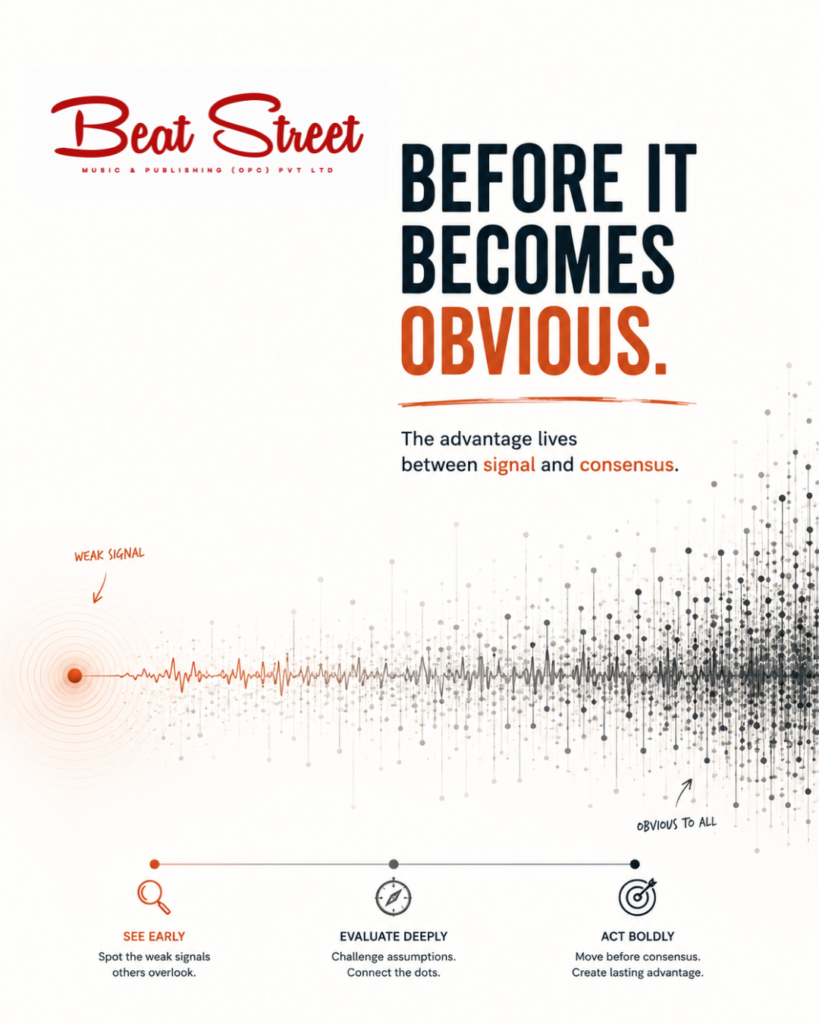
    Businesses want certainty before they act. But certainty is often what removes the advantage.

    The Earliest Signals Rarely Look Convincing

    The difficulty is that opportunities rarely announce themselves as opportunities.

    They begin as weak signals.

    A song unexpectedly gaining traction in one territory.

    An older recording being rediscovered by a younger audience.

    A small but unusual change in listener behaviour.

    A new licensing category beginning to emerge.

    An artist connecting deeply with a relatively small audience.

    None of these signals necessarily justify immediate investment.

    Most may lead nowhere.

    But occasionally, one represents the beginning of something much larger.

    The challenge is recognising which deserves attention before the evidence becomes overwhelming.

    Data Helps. It Cannot Remove Uncertainty.

    Modern music businesses have extraordinary visibility.

    Streaming analytics can identify audience behaviour.

    Social platforms reveal cultural momentum.

    AI can detect patterns across enormous datasets.

    Market intelligence can compare performance across artists, catalogues and territories.

    All of this improves decision-making.

    But no amount of information can completely eliminate uncertainty about the future.

    Data can tell us what is happening.

    It can help us understand why something may be happening.

    It can even suggest what could happen next.

    But eventually, someone still has to make a call.

    Wait for more evidence.

    Or act.

    That gap between evidence and action is where conviction begins.

    Conviction Is Not Instinct Without Evidence

    Acting early does not mean acting recklessly.

    There is an important difference between conviction and speculation.

    Speculation acts without adequately understanding the evidence.

    Conviction interprets incomplete evidence and accepts that certainty may never arrive in time.

    Strong decision-makers do not simply ask:

    Do we have enough information?

    They also ask:

    What would we need to believe for this opportunity to be worth pursuing?

    And perhaps more importantly:

    What will this opportunity look like if everyone else reaches the same conclusion six months from now?

    That changes the nature of the decision.

    The objective is no longer to eliminate uncertainty.

    It is to understand whether the potential advantage justifies acting before uncertainty disappears.

    Waiting Is Also A Decision

    Businesses often think of waiting as the safer option.

    Sometimes it is.

    But waiting carries its own risk.

    The artist may sign elsewhere.

    The catalogue may attract another buyer.

    The audience moment may pass.

    The licensing opportunity may become crowded.

    The cost of entry may increase.

    Doing nothing does not preserve the original opportunity indefinitely.

    Time changes it.

    This is why the cost of waiting should be considered alongside the risk of acting.

    Not every early signal deserves investment.

    But neither should every decision wait for overwhelming proof.

    The Advantage Exists Before Consensus

    The music business will continue to become better informed.

    More analytics.

    More predictive technology.

    More AI.

    More sophisticated market intelligence.

    That will help businesses identify opportunities faster.

    But it will also help everyone else identify them faster.

    Which means information alone may not create lasting advantage.

    The advantage may increasingly exist in the period between signal and consensus.

    When something is visible.

    But not yet obvious.

    When there is evidence.

    But not certainty.

    When acting still requires conviction.

    Because once everyone can see the opportunity, recognising it is no longer the advantage.

    Acting before consensus may be.

    Written by: Amit Dubey, Founder, Beat Street Music & Publishing, Music Business Strategist

  • Every Music Business Is Perfectly Designed To Produce Its Current Results

    When a music business underperforms, the explanation often comes quickly.

    The market changed.

    Streaming slowed.

    Competition increased.

    Algorithms shifted.

    Marketing wasn’t effective.

    The artist didn’t connect.

    Sometimes those explanations are true.

    But they can also become convenient explanations.

    Because they encourage businesses to look outward before looking inward.

    Conceptual illustration showing how organisational systems, leadership, incentives and strategic decision-making influence the long-term performance of a music business.

    What if the business is producing exactly the results its systems are designed to produce?

    That is an uncomfortable possibility.

    Because it suggests the biggest constraint may not be the market.

    It may be the organisation itself.


    Results Are Designed Before They Are Delivered

    Every organisation is shaped by the decisions it makes long before revenue appears.

    What gets measured.

    What gets rewarded.

    Where budgets are allocated.

    How quickly decisions are made.

    Who has authority.

    Which opportunities receive attention.

    Over time, these choices become systems.

    And systems quietly shape outcomes.

    Businesses often believe they are executing strategy.

    In reality, they are executing systems.


    Every Incentive Creates A Behaviour

    Consider a few examples.

    If A&R teams are rewarded primarily for signing new artists, catalogue development naturally receives less attention.

    If marketing success is measured by first-week streaming numbers, long-term catalogue growth becomes secondary.

    If publishing teams are evaluated only on registrations and royalty collections, commercial development may never become part of the conversation.

    If executives are rewarded primarily for quarterly performance, long-term catalogue investment naturally becomes harder to justify.

    None of these outcomes happen because people lack capability.

    They happen because organisations encourage certain behaviours more than others.

    People generally optimise for what success looks like inside their organisation.

    Not necessarily for what creates the greatest long-term value.


    Strategy Fails When Systems Disagree

    Many music businesses have ambitious strategies.

    Build catalogue value.

    Expand internationally.

    Increase sync revenue.

    Develop long-term artist careers.

    These are worthy objectives.

    But strategy rarely fails because it is unclear.

    It fails because the organisation continues rewarding different behaviour.

    Culture is often described as “the way things are done around here.”

    In reality, it is more accurately described as the cumulative effect of organisational incentives.


    Growth Doesn’t Automatically Create Complexity

    As businesses grow, complexity often grows with them.

    More releases.

    More artists.

    More meetings.

    More reports.

    More approvals.

    More technology.

    Each new process is usually introduced to solve a problem.

    Collectively, they can create another.

    Decision-making slows.

    Opportunities wait.

    Accountability becomes less clear.

    The organisation becomes busier.

    Not necessarily more effective.

    Complexity is rarely created by growth itself.

    It is created by the systems businesses build in response to growth.


    Great Organisations Design For The Results They Want

    Exceptional businesses rarely rely on good intentions.

    They design systems that make the desired behaviour more likely.

    If catalogue development matters, someone owns it.

    If sync matters strategically, someone is accountable for growing it.

    If long-term value matters, incentives reflect it.

    If commercial agility is important, decision-making is deliberately simplified.

    The point is not to control every outcome.

    No business can.

    The point is to ensure the organisation is structurally aligned with the future it is trying to create.


    The Hardest Question Leaders Should Ask

    Every leadership team regularly reviews financial performance.

    Perhaps they should also ask a different question.

    If our business continues operating exactly as it does today, are these the results we should expect?

    If the answer is yes, the market may not be the first place to look for change.

    The organisation may be.

    Markets influence results.

    Competitors influence results.

    Technology influences results.

    But over time, organisations also become architects of their own performance.

    Because businesses rarely produce outcomes by accident.

    More often, they produce the outcomes their systems quietly encourage every day.

    Written by: Amit Dubey, Founder, Beat Street Music & Publishing, Music Business Strategist

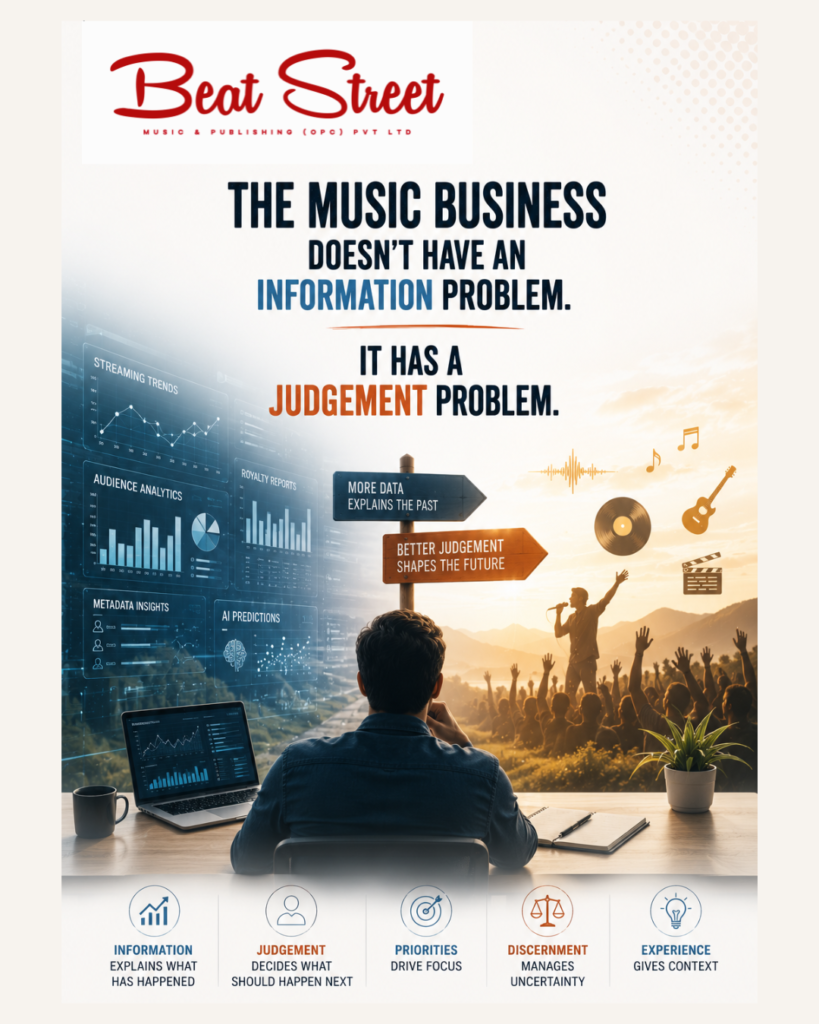
  • The Music Business Doesn’t Have an Information Problem. It Has a Judgement Problem.

    Every year, the music business becomes better informed.

    More streaming data.

    More audience analytics.

    More royalty reports.

    More metadata.

    More AI.

    More dashboards.

    More market intelligence.

    By almost every measure, the industry has access to more information than ever before.

    Yet businesses continue to miss opportunities.

    Catalogues remain underutilised.

    Sync opportunities disappear.

    Marketing budgets are misallocated.

    This raises an uncomfortable question.

    If the industry has more information than ever before, why aren’t commercial decisions improving at the same pace?

    Perhaps because information is no longer the constraint.

    Judgement is.

    Conceptual illustration representing judgement in the music business, showing how data, analytics and artificial intelligence support commercial decision-making while human judgement remains essential.

    The Information Plateau

    Every growing business eventually reaches a point where collecting more information produces diminishing returns.

    Additional dashboards reveal another trend.

    Another report identifies another audience segment.

    Another AI tool predicts another possibility.

    Information continues to grow.

    Decision quality does not.

    I increasingly think many organisations eventually reach what could be called the Information Plateau.

    The point at which more information stops producing proportionately better commercial decisions.

    Think about the last decade.

    Music businesses have invested heavily in streaming analytics, audience intelligence, reporting tools and artificial intelligence.

    Yet the industry’s biggest commercial questions remain remarkably similar.

    Which artists deserve long-term investment?

    Which catalogues should be acquired?

    Which songs deserve another chance?

    More information has improved visibility.

    It has not eliminated uncertainty.

    That is what makes the Information Plateau so significant.

    The constraint has shifted.

    Not from information to technology.

    But from information to judgement.


    Information Doesn’t Create Strategy

    Most music businesses already know what is happening.

    They know which songs are streaming.

    Which territories are growing.

    Which playlists are performing.

    Which releases generated revenue.

    The harder question is no longer what happened.

    It is what should happen next.

    Should resources be redirected?

    Should an older catalogue receive investment?

    Should a song be repositioned?

    Should an acquisition proceed?

    Should a catalogue remain untouched?

    None of these decisions are made by dashboards.

    They are made by people.


    Judgement Thrives Where Certainty Ends

    Judgement is not the ability to analyse more information.

    It is the ability to decide despite uncertainty.

    Every major commercial decision in the music business is made before complete certainty exists.

    Whether to sign an artist.

    Acquire a catalogue.

    Invest in a campaign.

    Enter a new market.

    Delay a release.

    The quality of those decisions rarely depends on having perfect information.

    It depends on exercising sound judgement.

    Information explains possibilities. Judgement creates priorities.


    AI Will Increase The Gap

    Artificial intelligence will dramatically increase the amount of information available to music businesses.

    Predictions.

    Recommendations.

    Audience modelling.

    Commercial forecasts.

    Metadata enrichment.

    Rights analysis.

    This will make information cheaper than ever.

    It will not make judgement easier.

    In fact, it may make it harder.

    Because more information often creates more possible decisions.

    An AI platform may identify fifty songs that appear commercially promising.

    It cannot decide which three deserve next quarter’s marketing budget.

    That remains a judgement call.

    The organisations that create the greatest long-term value will not necessarily have better technology.

    They will have better judgement about when to trust the technology—and when not to.


    Judgement Is Becoming The Competitive Advantage

    For years, competitive advantage came from having access to better information.

    Today, that advantage is disappearing.

    The same streaming data is available to competitors.

    The same AI tools are becoming widely accessible.

    The same analytics platforms serve thousands of businesses.

    Information is becoming democratised.

    Judgement is not.

    The organisations that consistently create value may not be those collecting the most data.

    They may be those making the clearest commercial decisions when everyone has access to similar information.


    The Next Generation Of Music Leaders

    Leadership in the modern music business is changing.

    The question is no longer:

    Who has the best information?

    It is increasingly:

    Who consistently exercises the best judgement?

    Because information explains what has happened.

    Judgement decides what should happen next.

    The future competitive advantage in the music business may not belong to those with the most information.

    It may belong to those who consistently exercise the best judgement when everyone has access to the same information.

    Because information has become abundant.

    Judgement remains scarce.

    Written by: Amit Dubey, Founder, Beat Street Music & Publishing, Music Business Strategist

  • The Biggest Cost in Music Isn’t Financial. It’s Opportunity Cost.

    Every music business knows what its catalogue earned last year.

    Monthly streaming revenue.

    Publishing royalties.

    Sync income.

    Neighbouring rights.

    Catalogue growth.

    Those numbers matter.

    But they tell only one side of the story.

    The bigger question is rarely asked.

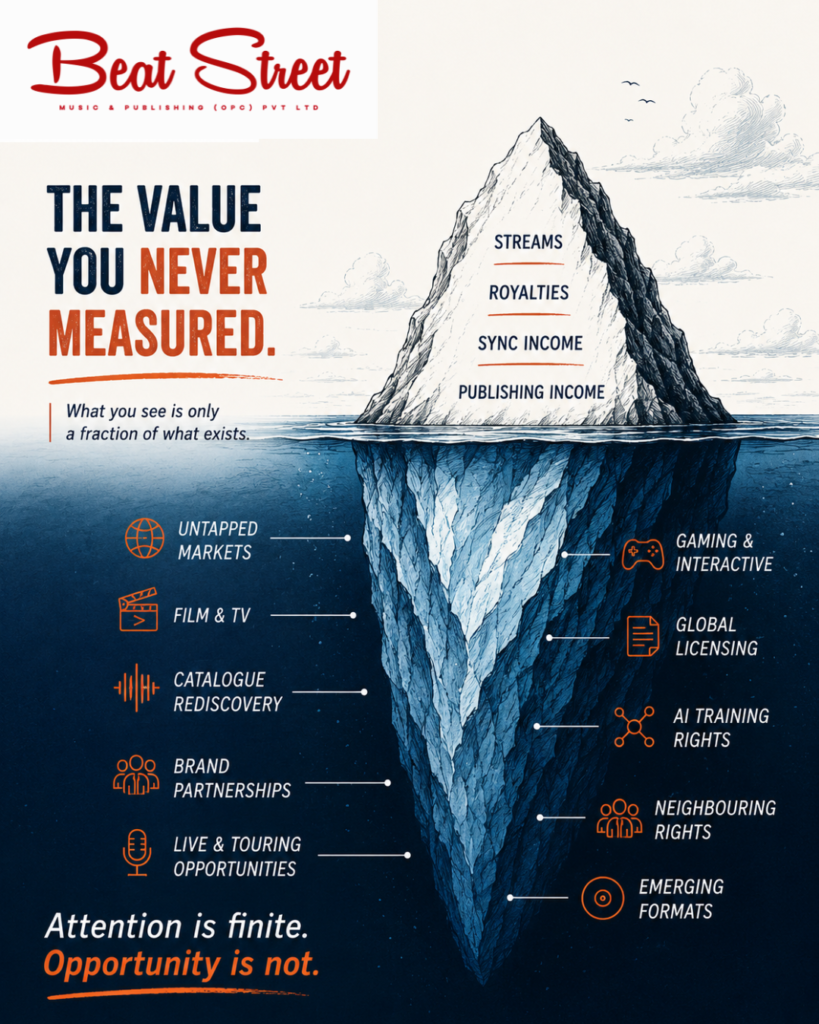
    How much value did your catalogue never have the opportunity to create?

    Not because the music lacked quality.

    But because commercial potential was never recognised.

    Never prioritised.

    Never pursued.

    Economists call this opportunity cost.

    The music business rarely measures it.

    Yet it may shape long-term catalogue value more than many of the numbers we track every month.

    The New Scarcity

    For decades, music companies competed by discovering better artists and creating better music.

    Today, great music has become more abundant than ever.

    Streaming has removed barriers to distribution.

    Independent artists can reach global audiences.

    Artificial intelligence is accelerating creation even further.

    Scarcity has moved.

    For years, music was the scarce resource.

    Today, commercial attention is.

    Not consumer attention.

    Commercial attention.

    The attention required to recognise opportunity before it disappears.

    Every catalogue is competing for the same finite pool of commercial attention.

    The challenge is no longer creating another song.

    It is recognising which existing song deserves the next commercial decision.

    That is the modern bottleneck.

    Every Song Is Competing for a Decision

    As catalogues grow, every commercial decision becomes an allocation decision.

    Should this song receive additional marketing support?

    Should that recording be pitched for sync?

    Should an older work be introduced into a new territory?

    Should resources be invested in a catalogue campaign or a new release?

    Should a forgotten recording be reintroduced to a new audience?

    Every choice to pursue one opportunity means another waits.

    Sometimes that is the right decision.

    Sometimes it quietly becomes the most expensive decision the business never knew it had made.

    Because opportunity cost rarely appears on a royalty statement.

    The Revenue Nobody Measures

    Unlike realised revenue, unrealised opportunity leaves almost no evidence.

    A catalogue track that was never pitched.

    A regional hit that never reached another market.

    A sync opportunity lost because ownership information was not immediately available.

    A catalogue review that never happened because attention remained focused on new releases.

    An artist partnership that began too late.

    None of these appear in financial reports.

    Yet collectively, they may represent some of the largest unrealised value sitting inside a music business.

    The absence of revenue is difficult to quantify.

    That does not make it commercially insignificant.

    Opportunity Is a Management Discipline

    Every catalogue contains more commercial possibilities than any team can realistically pursue.

    Not every opportunity deserves investment.

    But every opportunity deserves consideration.

    That distinction is becoming increasingly important.

    The businesses creating long-term value are often not those with the biggest catalogues.

    They are the ones with better systems for identifying, prioritising and acting on commercial opportunities before they disappear.

    The challenge is no longer discovering opportunity.

    It is discovering opportunity before competitors do, or before the moment passes.

    Timing is increasingly becoming part of catalogue strategy.

    Increasingly, catalogue management is becoming asset management.

    And asset management is fundamentally about making better decisions.

    The Next Competitive Advantage

    For years, competitive advantage came from discovering great music before everyone else.

    Increasingly, it may come from recognising the unrealised value already sitting inside the music you already own.

    Every catalogue contains unrealised commercial opportunities.

    The question is not whether they exist.

    The question is whether the business recognises them before they disappear.

    The businesses that learn to allocate commercial attention more effectively may ultimately outperform businesses with much larger catalogues.

    Because creating music creates assets.

    Recognising opportunity creates value.

    Over the next decade, that difference may quietly become one of the industry’s most sustainable competitive advantages.

    Written by: Amit Dubey, Founder, Beat Street Music & Publishing, Music Business Strategist

  • The Most Expensive Song In Your Catalogue Is Often The One Nobody Uses

    Ask most catalogue owners to identify their most valuable song and they will point to the obvious one.

    The biggest hit.

    The song generating the most streams.

    The track that appears on every royalty statement.

    The song everyone already knows has value.

    But that is not always where the greatest opportunity sits.

    Sometimes the most expensive song in a catalogue is one that generates almost nothing.

    Not because it lacks quality.

    Not because there is no audience for it.

    But because nobody has successfully connected that song to the opportunities capable of unlocking its value.

    Music catalogue analysis highlighting unrealised opportunities, hidden value and strategic rights management beyond royalty income.

    The music industry is remarkably good at measuring revenue.

    It is far less effective at measuring unrealised value.

    The sync placement that never happened.

    The cover recording that was never requested.

    The film producer who moved on to another song.

    The international opportunity that stalled before reaching the right decision-maker.

    The catalogue acquisition that was discounted because confidence was missing.

    None of these losses appear on a royalty statement.

    Yet collectively, they may represent more value than the revenue a catalogue currently generates.

    The Problem With Measuring Only What Happened

    Most catalogue reporting focuses on realised outcomes.

    Streams.

    Licences.

    Royalties.

    Collections.

    These numbers matter.

    But they only tell part of the story.

    They explain what happened.

    They tell us very little about what could have happened.

    For catalogue owners, that distinction is important.

    Because value is not created only by successful exploitation.

    Value is also shaped by missed exploitation.

    A song that generates modest revenue may still possess significant commercial potential.

    The question is whether the systems, visibility, relationships, and rights readiness surrounding that song allow the market to discover it.

    Opportunity Has Requirements

    Many opportunities are lost long before anyone realises they existed.

    A music supervisor searches for a particular type of song.

    A brand explores licensing options.

    A producer looks for a catalogue acquisition.

    An international partner evaluates a rights portfolio.

    In each case, the music is only one part of the equation.

    Visibility matters.

    Accessibility matters.

    Rights clarity matters.

    Commercial readiness matters.

    If any of those elements are missing, the opportunity often moves elsewhere.

    Not because the music lacked value.

    Because the catalogue was not positioned to capture that value.

    This is one of the least visible risks in catalogue ownership.

    Lost opportunities rarely leave evidence.

    The deal that never happened does not generate a report.

    The buyer who quietly moved on is never counted.

    The licence that was never considered never appears in a dashboard.

    Which means many catalogue owners underestimate the gap between realised value and potential value.

    The Strategic Question

    Most discussions about catalogue value focus on current earnings.

    A more useful question may be:

    How much value remains inaccessible?

    Not hidden inside the music.

    Hidden inside the way the catalogue is managed, positioned, documented, discovered, and presented to the market.

    This is where catalogue strategy becomes important.

    The strongest catalogues are not always the ones with the biggest hits.

    They are often the ones that maximise discoverability, confidence, readiness, and commercial flexibility across thousands of potential opportunities.

    Because catalogue value is not simply a reflection of what has already happened.

    It is also a reflection of what can happen next.

    Looking Beyond Revenue

    The future of catalogue ownership will increasingly favour those who think beyond royalty statements.

    Revenue remains important.

    But strategic catalogue management is ultimately about reducing friction between music and opportunity.

    The most valuable asset in a catalogue is not always the song generating the most income today.

    Sometimes it is the song whose value has never been fully unlocked.

    And that may also be the most expensive song in the catalogue.

    Not because it costs money.

    Because of everything it could have earned.

    Written by: Amit Dubey, Founder, Beat Street Music & Publishing

  • The Rights Questions Nobody Asks Until Money Is Involved

    Most rights questions in the music industry are not asked when a song is created.

    They are asked later.

    Much later.

    They surface when a catalogue is being sold.

    When a sync opportunity appears.

    When an investor starts due diligence.

    When a dispute emerges.

    When royalties stop matching expectations.

    Or when someone finally asks the question nobody thought to ask earlier:

    Who owns what?

    For years, a song can continue generating revenue despite gaps in documentation, incomplete records, unclear ownership information, or missing agreements.

    The music continues to move.

    The business around it often assumes everything is in order.

    Until money enters the conversation.

    Music rights documentation, contracts and ownership records being reviewed during catalogue due diligence and investment evaluation.

    The Illusion of Everything Being Fine

    One of the most common assumptions in the music business is that if royalties are arriving, the underlying rights must be functioning correctly.

    That is not always true.

    A catalogue can continue earning for years while carrying unresolved operational issues beneath the surface.

    In some cases, a catalogue may continue generating royalties for years despite missing songwriter splits, incomplete agreements, or outdated ownership records. The issue only becomes visible when a licensing opportunity, acquisition discussion, or dispute requires those rights to be verified.

    Missing agreements.

    Unrecorded ownership changes.

    Incomplete split information.

    Fragmented documentation.

    Unclear chains of title.

    These issues often remain invisible because they do not immediately stop revenue from flowing.

    The problem emerges when somebody needs certainty.

    The Questions That Suddenly Matter

    The moment value becomes visible, the questions begin.

    Can ownership be verified?

    Are the agreements accessible?

    Has every transfer of rights been documented?

    Do registrations reflect current ownership?

    Can historical decisions be traced?

    Is there evidence supporting the shares being claimed?

    Questions that once felt administrative suddenly become commercial.

    What was once paperwork becomes proof.

    And proof often becomes the difference between a smooth transaction and a delayed one.

    Why Buyers Think Differently

    When a buyer evaluates a music catalogue, they are not only assessing songs.

    They are assessing risk.

    Revenue is important.

    So is confidence.

    A catalogue that generates income but lacks supporting documentation creates uncertainty.

    And uncertainty has a cost.

    It can delay transactions.

    Reduce valuations.

    Increase legal review.

    Or in some cases, cause opportunities to disappear entirely.

    Investors are rarely paying only for earnings.

    They are paying for confidence in those earnings.

    The Hidden Cost of Delay

    Many rights issues are relatively easy to address when discovered early.

    They become significantly harder when discovered during a transaction.

    Locating agreements years later.

    Reconstructing ownership histories.

    Confirming verbal understandings.

    Tracking historical changes.

    None of these tasks become easier with time.

    In fact, they often become more expensive.

    The challenge is that rights management is usually viewed as a maintenance function rather than a value preservation function.

    That perception may need to change.

    Rights Become Important Long Before They Become Visible

    The music industry often focuses on monetisation.

    Streaming.

    Licensing.

    Publishing.

    Catalogue acquisitions.

    New technologies.

    New revenue models.

    Yet all of these activities depend on one thing:

    Confidence in ownership.

    The strongest catalogues are not simply collections of successful songs.

    They are collections of rights that can be understood, verified, administered, and trusted.

    That work often happens quietly.

    Long before a deal appears.

    Long before a dispute emerges.

    And long before anyone starts asking questions.

    Because by the time money is involved, the answers are expected to exist already.

    Rights questions rarely become urgent when music is created.

    They become urgent when value needs to be proven.

    And by then, the answers are expected to exist already.

    Written by: Amit Dubey

    Founder, Beat Street Music & Publishing