Music businesses are constantly making decisions.
Which artist to invest in.
Which market to enter.
Which partnership to pursue.
Which technology to adopt.
Which opportunity to decline.
Most of these decisions are evaluated through a familiar lens:
What value will this create?
That is an important question.
But in an industry where technology, consumer behaviour and commercial opportunities can change quickly, there may be another question worth asking:
What choices will this decision leave us tomorrow?
Because sometimes the value of a decision lies not only in what it creates.
It lies in what it keeps possible.
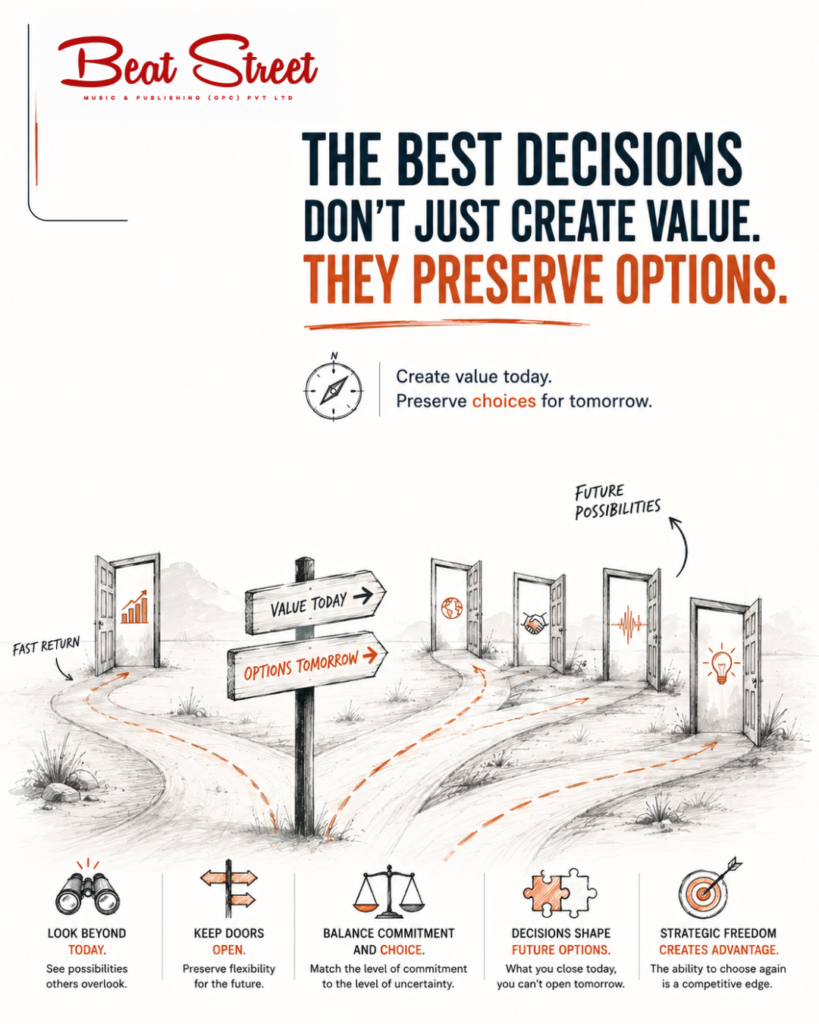
The Strategic Value Of Optionality
Optionality is the ability to preserve multiple future choices without having to commit fully to one today.
It matters because the future rarely develops exactly as businesses expect.
A new technology may create an opportunity that does not exist today.
A market may develop faster than anticipated.
A new audience may emerge.
A commercial model may change.
A partnership may create possibilities that were impossible to see when the initial decision was made.
No business can accurately forecast all of these outcomes.
But businesses can make decisions that leave them better positioned to respond when circumstances change.
That is the strategic value of optionality.
Optionality is not about predicting the future.
It is about preserving the ability to respond to it.
Not All Decisions Are Equally Reversible
One of the simplest ways to think about a strategic decision is to ask:
How difficult would this be to reverse?
Some decisions are relatively easy to change.
A business can test a new market.
Pilot a partnership.
Experiment with a positioning strategy.
Run a limited campaign.
Allocate a small amount of capital to test an emerging opportunity.
If the decision proves wrong, the business can adjust.
Other decisions are much harder to reverse.
Long-term exclusivity.
Major acquisitions.
Restrictive commercial commitments.
Structural technology decisions.
Agreements that limit future strategic flexibility.
These decisions may still be absolutely right.
But they deserve a different level of scrutiny because they do more than allocate resources.
They reduce future choices.
The Reversibility Principle
This leads to a simple principle:
The less reversible a decision is, the more carefully it should be evaluated before commitment.
And there is an important counterpart:
The more reversible a decision is, the less reason there may be to wait for certainty.
That distinction can change how businesses approach uncertainty.
If a decision can easily be reversed, a business may be better served by testing it and learning from the result.
If a decision is difficult or expensive to reverse, stronger evidence may be worth waiting for.
The objective is not to eliminate uncertainty.
It is to match the level of commitment to the level of uncertainty.
Sometimes The Best Decision Is A Smaller Decision
Businesses often frame decisions as binary choices.
Do we enter the market or not?
Do we invest or not?
Do we pursue the partnership or not?
Do we adopt the technology or not?
But there is often a third option:
Can we make a smaller, reversible decision first?
Test the market before committing significant resources.
Pilot the technology before restructuring the organisation around it.
Explore the partnership before granting exclusivity.
Run a limited campaign before scaling the investment.
A smaller decision can generate information that a larger decision could not.
This changes the relationship between action and uncertainty.
You don’t always need more information before acting. Sometimes you need to act in a way that generates better information.
The Cost Of Commitment
Commitment has value.
It can create focus.
It can unlock resources.
It can strengthen relationships.
It can produce scale.
But commitment also has a cost that is often overlooked:
It can reduce strategic freedom.
A decision may produce attractive economics today while limiting what the business can do tomorrow.
That does not make the decision wrong.
It means the full cost of the decision cannot be understood by looking only at its immediate financial return.
A strategic decision has two dimensions:
What does it create?
And:
What does it close?
The second question is often harder to see.
When Flexibility Becomes More Valuable
The more uncertain the environment, the more valuable flexibility can become.
Music is an obvious example.
Artificial intelligence is changing how music is created and commercialised.
Platforms continue to reshape discovery.
Audience behaviour moves rapidly.
New licensing opportunities emerge.
Business models evolve.
Some developments will create enormous value.
Others will disappear.
No leadership team can know which is which with complete confidence in advance.
In such an environment, flexibility is not indecision.
It can be a strategic asset.
The goal is not to avoid commitment.
It is to avoid committing more than the evidence justifies.
The Question Leaders Should Ask
Before making a significant decision, leaders often ask:
What is the potential return?
What could go wrong?
What does the data tell us?
Those questions matter.
But there is another question worth adding:
What becomes impossible if we make this decision today?
That question changes the conversation.
It forces leaders to consider not only the value they are pursuing, but also the choices they may be giving up.
And sometimes that is where the most important strategic insight lies.
The Future Rewards Strategic Freedom
No music business knows exactly what the industry will look like five years from now.
Which platforms will dominate.
Which technologies will matter.
Which audiences will emerge.
Which business models will succeed.
The objective cannot be to predict all of it.
The objective is to build a business capable of responding when the future becomes clearer.
That requires conviction when an opportunity deserves commitment.
But it also requires discipline when uncertainty remains high.
Because the best strategic decision is not always the one that creates the greatest value today.
Sometimes it is the one that creates value without unnecessarily closing tomorrow’s possibilities.
Good strategy is not only about choosing what to do.
It is also about preserving the ability to choose again.
Written by: Amit Dubey, Founder, Beat Street Music & Publishing, Music Business Strategist
Leave a Reply