Music businesses accumulate enormous amounts of information over the years.
Contracts.
Metadata.
Royalty statements.
Registrations.
Emails.
Deal terms.
Reports.
Most of it is stored somewhere.
But storing information and preserving what the organisation actually knows are not quite the same thing.
You may still have the contract from ten years ago.
But does anyone remember why a particular clause was negotiated?
You may have all the emails relating to an old deal.
But does anyone remember what was happening at the time, what the concerns were, or why the final decision was made?
The information survives.
The understanding around it often doesn’t. And I think this becomes a bigger issue as music businesses grow
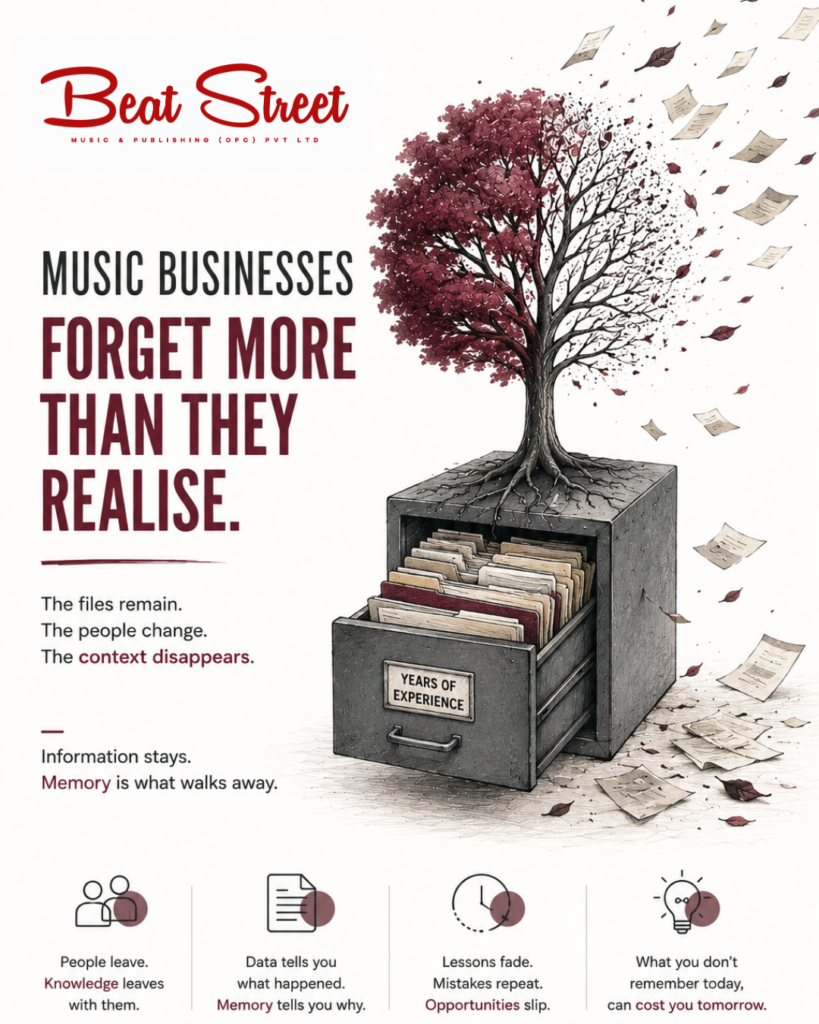
The People Leave. The Context Often Leaves With Them.
People move on.
Teams change.
Companies restructure.
Consultants finish their assignments.
Founders step back.
Systems get replaced.
Usually, the files remain.
But the people who understood the history behind those files may not.
Someone knew why an unusual rights arrangement existed.
Someone remembered why a particular artist relationship needed to be handled differently.
Someone knew why a market had been deprioritised.
Someone understood the background to an old dispute.
Someone remembered the mistake that led to a particular process being introduced.
Very little of this fits neatly into a spreadsheet.
Some of the most useful knowledge inside a business lives in conversations, relationships, experience and memory.
And when people leave, some of it leaves with them.
Data Can Tell You What Happened. It Can’t Always Tell You Why.
A database can tell you when something was delivered.
It may not tell you why it was delayed.
A contract can tell you what was agreed.
It may not tell you why both sides agreed to those particular terms.
A report can show that a market underperformed.
It may not capture everything the team learned while trying to enter it.
The information may still exist.
But the context around it slowly fades.
And without that context, businesses can find themselves trying to solve problems they have already solved before.
Or questioning decisions without knowing why those decisions were made in the first place.
The Business Ends Up Learning The Same Lesson Twice
This usually doesn’t happen dramatically.
It happens in small ways.
A new employee spends days trying to understand something the previous team already knew.
A rights issue gets investigated again.
A relationship has to be understood from scratch.
Someone changes an old process, only to discover later that there was a very good reason it existed.
A team tries something that another team tried unsuccessfully five years earlier.
None of these incidents may look particularly serious on their own.
But collectively they tell us something interesting.
A business can have twenty years of history without necessarily retaining twenty years of learning.
Because experience belongs to people before it belongs to organisations.
Unless some of that experience survives them, the business can end up rediscovering its own knowledge.
Sometimes, it repeats its own mistakes.
Not because nobody learned the lesson.
Because the lesson didn’t survive.
Growth Makes This Harder
In a small business, this problem is easier to manage.
The founder remembers most of the important decisions.
Senior people know the history.
If somebody has a question, there is usually someone in the room who remembers what happened.
As the company grows, that becomes harder.
More people join.
More people leave.
More catalogues are added.
More markets are entered.
More relationships develop.
More systems are introduced.
Knowledge gets spread across different people and teams.
Ironically, the business may now have more information than ever before while fewer people understand the history behind all of it.
Not Everything Needs To Be Remembered
Of course, the answer isn’t to document everything.
Nobody needs a permanent record of every conversation or every minor decision.
That would probably create another problem altogether.
But there is a useful question here:
What does our business know today that it cannot afford to forget tomorrow?
Maybe it is the history behind an unusual agreement.
The reasoning behind an important commercial decision.
The lessons from something that went badly wrong.
The background to an important relationship.
The assumptions behind a strategy.
The reason an exception was made.
These things may never appear on a balance sheet.
But they can influence decisions years later.
And that gives them value.
Technology Can Find The File. That Doesn’t Mean It Knows The Story.
This may become even more interesting in the age of AI.
We are getting much better at storing and retrieving information.
AI will make it easier to search years of emails, agreements, reports, meeting notes and other business records.
That is enormously useful.
But finding the information is only part of the problem.
The agreement may tell you what happened.
The emails may give you pieces of the conversation.
The reports may show you the numbers.
But unless the important context was captured somewhere, technology cannot retrieve something the organisation never preserved.
There is a difference between being able to find an old decision and understanding why it made sense at the time.
Experience Is Also Something A Business Builds
Music businesses spend years building assets.
Catalogues.
Rights.
Relationships.
Technology.
Teams.
But they also build something less visible.
Experience.
Every difficult negotiation teaches something.
Every failed initiative teaches something.
Every unusual rights problem teaches something.
Every market entered, relationship built and mistake made adds to what the organisation knows.
We usually think of that experience as belonging to the company.
But companies don’t remember things.
People do.
Which means experience only becomes organisational knowledge if some part of it survives the people who originally acquired it.
That is why this isn’t simply a documentation problem.
It is a continuity problem.
A Question Worth Asking
Every growing music business should occasionally ask:
What do we know today that we may no longer know five years from now?
Not what files will we still have.
Not what data will still exist.
What will we still understand?
Because a company can keep every contract, every report and every spreadsheet and still lose something valuable along the way.
The history behind a decision.
The lesson behind a mistake.
The context behind an agreement.
The understanding behind a relationship.
Music businesses spend a great deal of time thinking about the assets they need to protect.
Perhaps some thought should also go into protecting what the organisation has learned while building those assets.
Because organisations don’t only lose knowledge when information disappears.
Sometimes all the information is still there.
What disappears is the memory that made it useful.
Written by:
Amit Dubey
Founder, Beat Street Music & Publishing | Music Business Strategist
Leave a Reply