Every strategy is built on assumptions.
A business decides where to invest, which markets to prioritise, which capabilities to build, which partners to work with and which opportunities to pursue.
Behind those decisions is a belief about how the world works.
Sometimes that belief is explicit. Often, it isn’t.
This is where future growth will come from.
This is the market worth prioritising.
This is the capability we need to build.
This is where commercial value will be created.
At the time those assumptions are made, they may be entirely reasonable.
The problem is that strategies can outlive the conditions on which they were built.
Markets evolve. Technology changes. Audience behaviour shifts. Economics change with them.
Yet the assumptions underneath a strategy can remain in place long after the environment that made them reasonable has begun to change.
The business keeps executing, and the strategy may continue producing results.
That is precisely what can make the problem difficult to see.
A strategy does not necessarily stop working the moment its assumptions begin to weaken.
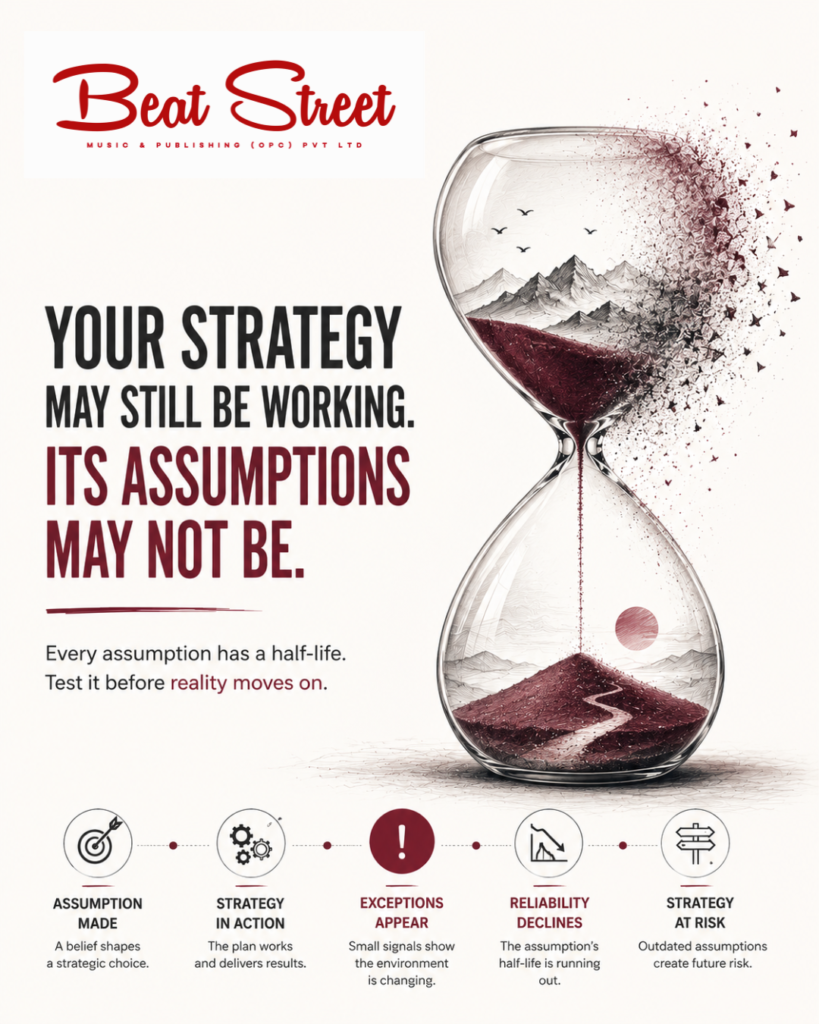
The Assumption Half-Life
Every strategic assumption has a period during which it remains reliable.
Over time, that reliability can decline.
Not because the assumption suddenly becomes completely wrong, but because the conditions that made it true begin to change.
I think of this as the Assumption Half-Life.
The period over which a strategic assumption gradually becomes less reliable as the environment around it changes.
This rarely happens overnight.
At first, the strategy continues to work.
Then exceptions begin to appear.
A market starts behaving differently from expectations. A customer pattern shifts. New technology changes the economics. A capability that once created an advantage becomes widely available.
The original assumption may still appear broadly correct, so the exceptions are easy to dismiss.
Until they are no longer exceptions.
By then, the business may have spent years operating on logic that was gradually becoming less reliable.
The Danger Of Continued Adequacy
Failure is obvious.
It creates urgency and forces difficult questions.
Adequacy can be more dangerous.
A strategy that is still producing acceptable results creates very little pressure to examine itself. Targets may broadly be achieved. Revenue may still be growing. Customers may still be responding.
So the assumptions underneath the strategy remain largely unchallenged.
This creates a different kind of strategic risk.
Failure creates evidence.
Adequacy creates comfort.
And comfort can allow an ageing assumption to survive far longer than it should.
Poor strategies are often easier to question than adequate ones.
Poor performance demands attention.
Adequate performance can protect outdated thinking.
The assumption survives not necessarily because it has been tested recently, but because nothing has gone sufficiently wrong to force the business to test it.
Execution Can Improve While Strategy Ages
Businesses are usually very good at improving execution.
Campaigns are optimised. Processes are refined. Technology is upgraded. Teams become more efficient. Costs are reduced.
But execution can improve while the assumption underneath the strategy quietly deteriorates.
A business can become exceptionally good at executing an idea that is becoming increasingly wrong.
That is one of the more uncomfortable possibilities in management.
Better execution can create the appearance of progress. The business becomes faster, more efficient and more disciplined.
But efficiency cannot correct a weakening assumption.
It can simply make the business more efficient at following it.
So the question is not only:
How well are we executing this strategy?
It is also:
What still needs to be true for this strategy to make sense?
Improving execution and testing the assumptions underneath a strategy are not the same activity.
Both are necessary.
The Assumption Is Often Hidden Inside The Strategy
The most important assumptions are not always written down in a strategy document.
They are often embedded in decisions that have become routine.
How budgets are allocated.
Which markets receive attention.
What success is measured against.
Which capabilities are built internally.
Which relationships receive investment.
Over time, these decisions begin to feel normal, and the reasoning behind them becomes less visible.
Eventually, people may defend a decision without being able to clearly articulate the assumption that originally justified it.
That is when assumptions become particularly difficult to challenge.
Not necessarily because they are correct.
But because they have become part of how the organisation operates.
Familiarity begins to feel like evidence.
A Simple Example
Consider a music business that has historically invested most of its commercial resources in a particular market.
That decision may have been based on sound assumptions. The market was larger, revenue was stronger, relationships were more established and the audience was easier to reach.
Over time, however, conditions change.
Another market begins growing faster. Audience behaviour shifts. New commercial opportunities emerge.
The original market may still be important, and the existing strategy may still produce results.
But the question is no longer whether the original decision was wrong.
The question is whether the assumptions supporting that decision remain strong enough to justify making the same allocation today.
A decision can have been right when it was made and still deserve to be reconsidered now.
The Today Test
One useful way to challenge an ageing strategy is what I would call the Today Test.
Ask:
If we were making this decision today, knowing what we know now, would we still make the same choice?
It is a simple question, but it can expose the difference between strategic commitment and strategic inertia.
If the answer is yes, the strategy may still be well supported.
If the answer is no, a more difficult question follows:
Why are we continuing to operate as though we would?
The Today Test does not mean abandoning every existing strategy.
Businesses need consistency. Long-term commitments require patience, and changing direction too frequently can be as damaging as failing to change at all.
The purpose is not constant reinvention.
It is periodic renewal.
Test The Assumption Before It Fails
Perhaps the more useful discipline is to identify assumptions before they become a problem.
For any significant strategy, leadership teams should periodically ask:
What must remain true for this strategy to continue working?
Which of those assumptions have we actually tested recently?
What evidence would tell us that one of them is weakening?
What changes are we currently dismissing as exceptions?
And perhaps most importantly:
What would have to stop being true for us to change our strategy?
That final question matters because it creates a threshold for reassessment before failure forces one.
It turns assumptions from invisible beliefs into things that can actually be examined.
And that may be one of the most useful forms of strategic discipline.
The Quiet Risk Behind A Working Strategy
Strategic risk is often associated with making the wrong decision.
Entering the wrong market. Investing in the wrong capability. Choosing the wrong partner. Backing the wrong technology.
But another form of risk is quieter.
Continuing to make decisions based on assumptions that were reasonable when they were formed but have gradually become less reliable.
The strategy may still be working.
That does not mean its assumptions are.
And that may be precisely what makes the risk difficult to recognise.
Because the greatest strategic danger is not always doing the wrong thing.
Sometimes it is continuing to do the right thing for conditions that no longer exist.
Every strategy is built on assumptions.
The strongest businesses do not simply execute their strategies well. They know when to examine the assumptions underneath them.
Because every assumption has a half-life.
The question is whether the business notices when that half-life is beginning to run out.
Written by:
Amit Dubey
Music Business Strategist | Founder, Beat Street Music & Publishing
Leave a Reply