Music businesses have never had more things to measure.
Streams.
Views.
Followers.
Engagement.
Audience growth.
Playlist activity.
Revenue.
Territory performance.
Catalogue consumption.
And that’s a good thing.
Better information has helped the music business understand audiences, markets and performance in ways that were difficult to imagine not very long ago.
But I have been thinking about another side of measurement.
Once you start measuring something, people start paying attention to it.
And once people know they are being judged on it, something else happens.
They start trying to improve it.
That sounds obvious.
But I think it has bigger consequences than we sometimes realise.
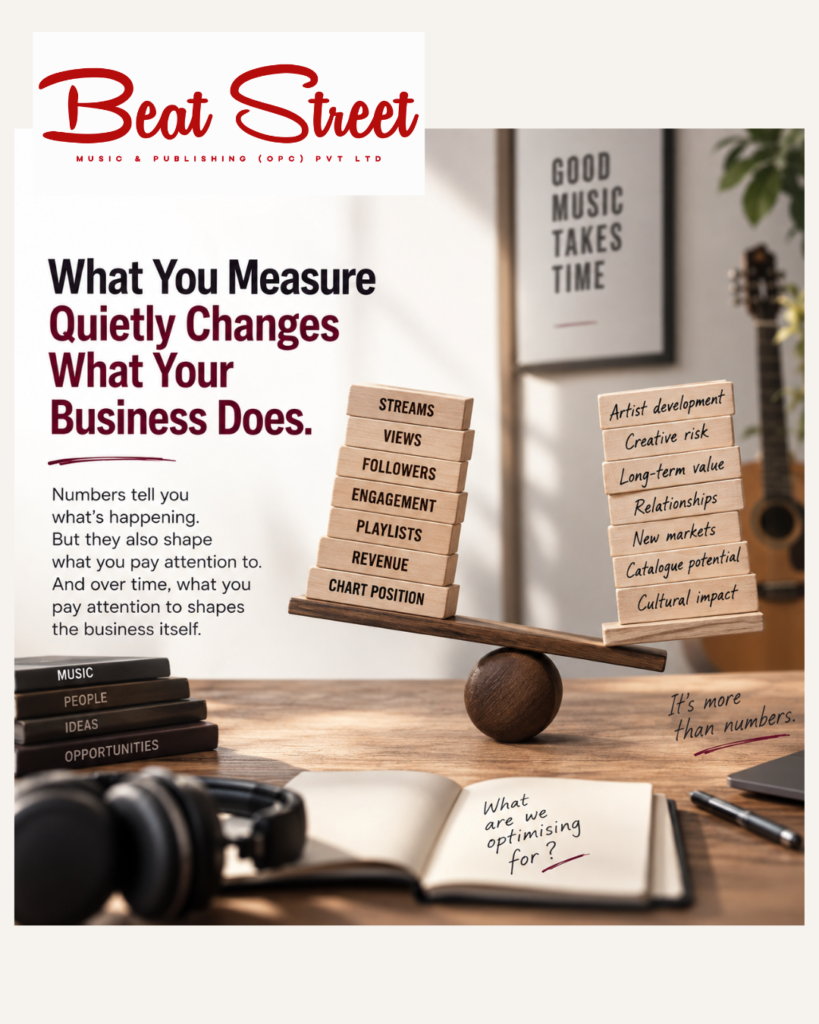
A Number Doesn’t Just Measure Behaviour
Suppose an artist’s performance is discussed primarily through first-week streams.
Naturally, a lot of energy will go into improving first-week streams.
If a marketing team is evaluated mainly on reach and engagement, reach and engagement will receive more attention.
If catalogue performance is discussed primarily through current revenue, the catalogue generating revenue today will probably find it easier to attract internal attention than something whose potential is less obvious.
None of this means the measurements are wrong.
The numbers may be perfectly useful.
But at some point, they stop simply describing what the business is doing.
They begin influencing what the business does.
That distinction is important.
People Learn What The Organisation Really Values
Every company has things it says are important.
Long-term artist development.
Building valuable catalogues.
Entering new markets.
Strengthening relationships.
Experimenting with new ideas.
But people working inside an organisation also notice something else:
What actually gets discussed?
What gets reviewed every Monday?
What appears on the dashboard?
What does senior management ask about?
What determines whether a campaign is considered successful?
What gets rewarded?
That is often where the real priorities of an organisation become visible.
A company may genuinely believe in long-term artist development.
But if every important conversation is about this week’s streaming numbers, people will naturally respond to the numbers.
Not because they don’t believe in the long term.
Because they understand what gets noticed.
Some Valuable Things Take Time To Show Up
This is particularly interesting in music.
Not everything valuable produces an immediate number.
An artist may be building a small but unusually committed audience.
A relationship developed in a new market may take years to produce meaningful business.
A catalogue track may slowly begin finding a different generation of listeners.
A decision to clean up rights or metadata may not produce an exciting result next quarter, but could make future licensing or administration considerably easier.
A creative experiment may fail commercially and still teach the team something useful.
Eventually, some of these things may show up in the numbers.
Some may not.
That doesn’t automatically make them less valuable.
It simply makes them harder to see on a dashboard.
And businesses naturally find it easier to manage what they can see.
The Dashboard Can Quietly Become The Conversation
Dashboards are useful.
I have worked with data and information for a large part of my career, so I would certainly not argue otherwise.
But there is a difference between using a dashboard to understand the business and allowing the dashboard to define the business.
If five numbers appear in every management meeting, those five numbers will become important.
People will prepare for them.
Teams will explain them.
Managers will ask how to improve them.
Resources may gradually move towards them.
Meanwhile, something important that isn’t represented by a number can struggle to enter the conversation at all.
That is where measurement can create an unintended blind spot.
What isn’t measured can slowly start to look like what doesn’t matter.
And those are not always the same thing.
Sometimes The Measurement And The Strategy Disagree
This is where I think the question becomes more interesting.
Imagine a label saying:
We want to build artists for the long term.
But most internal success conversations revolve around short-term streaming performance.
Or a business saying:
International growth is important to us.
But its reporting doesn’t really help teams understand how individual markets are developing.
Or a catalogue company saying:
We want to discover new value in our existing repertoire.
But almost every catalogue discussion begins and ends with current revenue.
There is nothing wrong with measuring streams or revenue.
Of course those numbers matter.
The problem is the contradiction.
The strategy is asking people to look in one direction while the measurement system is pulling their attention somewhere else.
And in day-to-day business, I suspect the measurement system often wins.
Because it is visible.
It is repeated.
And somebody will probably ask about it in the next meeting.
Maybe We Should Ask A Different Question
When businesses design reporting, the obvious question is:
What do we need to measure?
Perhaps there is another question worth asking alongside it:
If we measure this repeatedly, what behaviour are we likely to encourage?
If we obsess over first-week performance, what happens to patience?
If we reward volume, what happens to quality?
If we measure activity, are we necessarily measuring progress?
If we focus heavily on current revenue, what happens to opportunities that need investment before they generate revenue?
And perhaps the most uncomfortable question:
What do we say is important but rarely measure, discuss or reward?
The answers may tell us quite a lot about the business.
More Technology Will Make This More Important, Not Less
AI and analytics will give music businesses the ability to measure more.
More signals.
More behaviour.
More patterns.
More predictions.
More performance indicators.
That will undoubtedly help businesses make better decisions.
But more measurement also means more choices about what deserves attention.
Technology can tell us what is measurable.
It cannot decide what should matter to the organisation.
That’s still a management decision.
And perhaps that’s the part we should think about more carefully.
Because a metric is never just a number sitting on a dashboard.
Once an organisation starts paying attention to it, talking about it and rewarding it, that number begins to influence behaviour.
What we measure shapes what people notice.
What people notice shapes what they work on.
And over time, what people work on shapes the business itself.
So perhaps the question isn’t whether music businesses need more metrics.
We probably already have enough.
The better question may be:
Are the things we measure helping us become the business we actually want to become?
Written by:
Amit Dubey
Founder, Beat Street Music & Publishing | Music Business Strategist
Leave a Reply