Music businesses have become very good at finding new ways to make money.
Distribution.
Publishing.
Artist services.
Management.
Licensing.
Sync.
Brand partnerships.
Live.
Technology.
In many cases, adding another revenue stream looks like progress.
And sometimes it is.
But I’ve been thinking about something.
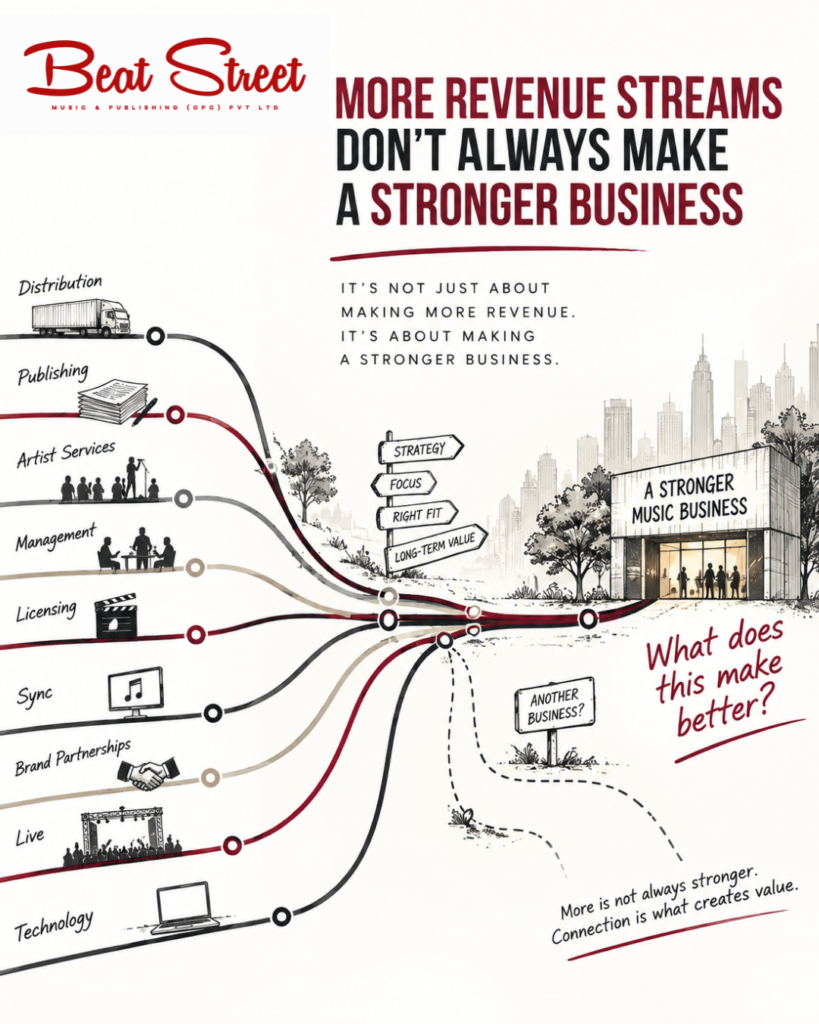
At what point does diversification stop making a business stronger and simply make it more complicated?
Because a new revenue stream can generate revenue without necessarily strengthening the business around it.
A company can be doing ten different things and still struggle to explain why those things belong together.
That matters because every new business line brings more than revenue.
It brings people.
Systems.
Customers.
Decisions.
Costs.
Management attention.
And often, a completely different way of working.
So I think there is a question that music businesses should ask before adding another line of business:
What does this make better?
Not every adjacent business is actually adjacent
Take distribution and artist services.
They can fit together naturally.
The company may already have relationships with the artists. It already understands their releases. It already has data around their activity. It may be able to use what it already knows to provide additional value.
The second business can make the first relationship more valuable.
Now take distribution and publishing.
They may look like obvious partners because they both sit inside the music industry.
But the connection is not automatic.
That doesn’t mean they can’t strengthen each other. It means the connection has to be built rather than assumed.
The rights are different.
The workflows are different.
The systems can be different.
The expertise required is different.
The commercial models are different.
So the fact that both businesses involve music does not, by itself, make them strategically connected.
The same applies to labels moving into live, or artist companies moving into brand partnerships, or technology companies adding rights administration.
There may be a very good reason to do it.
But the question should not simply be:
Can we make money from this?
It should be:
Why us?
And perhaps more importantly:
What advantage do we already have that makes us particularly good at doing this?
Revenue can grow while the business gets weaker
This is where diversification can become deceptive.
Imagine a company adding one successful business after another.
Each one makes sense independently.
One generates revenue from distribution.
Another from management.
Another from sync.
Another from marketing.
Another from live.
The numbers look good.
But underneath the numbers, the organisation may be becoming increasingly fragmented.
Different teams are solving different problems.
Different businesses are chasing different customers.
Management attention is spread across multiple operating models.
The founder becomes the connection point between businesses that otherwise have very little connecting them.
At some point, the company may be doing more things without actually becoming a stronger business.
And that is difficult to see from a revenue statement.
A revenue statement can tell you where the money came from.
It cannot necessarily tell you whether the businesses making that money are making one another stronger.
A list is not a business model
This is the distinction I find most interesting.
A company can say:
We do distribution, publishing, management, sync, marketing, live and technology.
That is a list.
But imagine a different structure.
Distribution creates relationships with artists.
Those relationships create opportunities for artist services.
Those services produce deeper knowledge about the artists and their audiences.
That understanding creates better licensing opportunities.
Licensing activity reveals where demand is emerging.
That information influences repertoire decisions.
Those decisions create better opportunities for the original artist relationships.
Now there is something different happening.
One activity is making another activity more valuable.
There is a loop.
And loops are very different from lists.
The difference may look subtle from the outside.
Inside the business, it can be enormous.
So what does this make better?
This is the question I would keep asking whenever a new business opportunity appears.
Does it make something we already own more valuable?
Does it deepen a relationship we already have?
Does it make something we are already good at more useful?
Does what we learn from this improve another part of the business?
The answer does not have to be yes to everything.
But there should be a reason the new business belongs.
Otherwise, you may not be expanding the business.
You may simply be starting another one.
And there is nothing wrong with starting another business.
It just needs to be treated honestly as one.
It needs its own economics.
Its own capabilities.
Its own leadership attention.
Its own investment decisions.
The danger comes when a company assumes that because two businesses sit under the same logo, they automatically create strategic value for each other.
They don’t.
The hidden cost of another revenue stream
There is another reason this matters.
Every new revenue stream competes for something that is harder to measure than money.
Management attention.
A founder can approve a new business line in a meeting.
But the organisation has to live with it every day.
Someone has to hire for it.
Someone has to build the systems.
Someone has to manage the clients.
Someone has to solve the problems.
Someone has to decide what gets prioritised when two parts of the business need attention at the same time.
This is why a new revenue stream can have a very different cost from the number that appears on the business plan.
It can consume attention that was previously being used to make the core business better.
And that’s difficult to see in a business plan.
The projected revenue is visible.
The attention being pulled away from somewhere else usually isn’t.
Growth Should Make Something Stronger
The strongest diversification, in my view, does not simply increase the number of things a company sells.
It creates additional value from what the company has already built.
The same relationship becomes more valuable.
The same asset can be monetised in more ways.
The same capability can be used across multiple businesses.
The same information can improve more decisions.
That is when expansion starts to feel less like adding another business and more like strengthening the original one.
It is also why two companies with the same number of revenue streams can look very different from the inside.
One may simply have more businesses.
The other may have built a business where each activity makes the others stronger.
That difference rarely appears in a pitch deck.
But it can determine how durable the company becomes.
Before adding the next one
The next time a music business considers adding another revenue stream, the conversation will probably begin with the opportunity.
How big is the market?
How much money can we make?
How quickly can we launch?
Who are the competitors?
All useful questions.
I would add one more.
What does this make better?
Not because every new business has to strengthen the existing one.
Sometimes a genuinely new opportunity is worth pursuing on its own.
But knowing the difference matters.
Because there is a big difference between having several ways to make money and building a business where those ways of making money reinforce each other.
The first can make a company bigger.
The second can make it stronger.
And as music businesses keep finding new services, new opportunities and new ways to generate revenue, I think that distinction will matter more and more.
So before adding the next one, perhaps the question isn’t only:
How much money can this make?
But:
What does this make better?
Written by:
Amit Dubey
Founder, Beat Street Music & Publishing | Music Business Strategist