There is a phase in every release where music is already generating value. And almost no one is tracking it.
A song goes live.
It reaches listeners.
Streams begin almost instantly.
From the outside, this looks like the starting point of everything that follows, including revenue.
But that assumption doesn’t quite hold.
Because while consumption begins immediately, the systems responsible for recognising and accounting for that value do not move at the same speed.
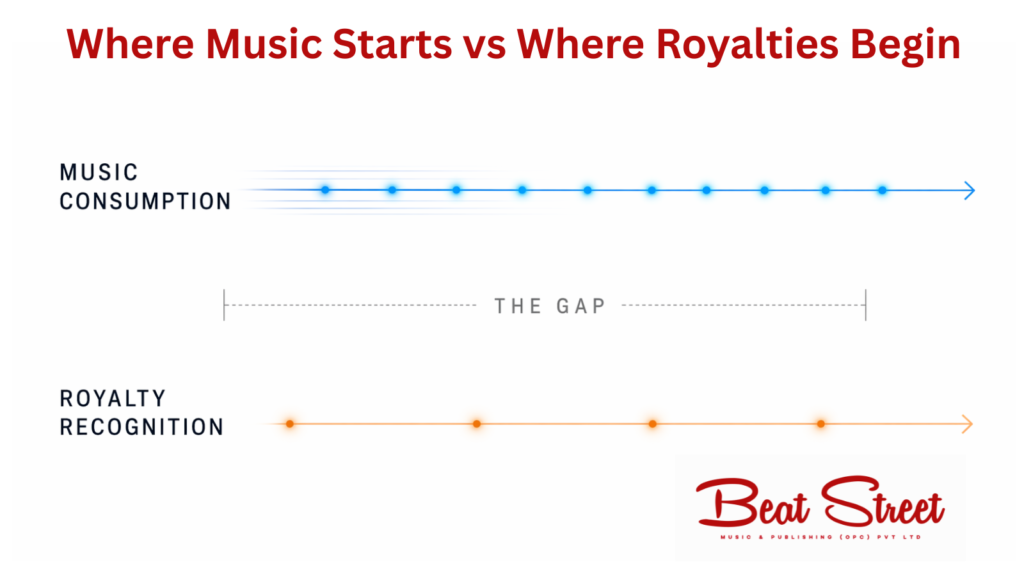
Between release and full royalty recognition, there is a gap.
Not always visible.
Not always acknowledged.
Almost never measured.
Call this the revenue window.
This is not about incorrect data. It is about timing.
In this early phase, different parts of the same asset exist in different states of readiness.
The recording is live and monetisable.
Basic credits may be visible.
Distribution pipelines are active.
But the deeper layers that connect usage to ownership are still catching up.
Publishing information may not be fully aligned across systems.
Identifiers may not yet be consistently mapped.
Ownership structures may exist, but not in a form that all systems can interpret simultaneously.
Nothing looks wrong.
That is why the phase goes unnoticed.
There is no alert that says:
“Revenue should have started here.”
Instead, what exists is a quiet window where music is being consumed, but the system is not yet fully ready to recognise that consumption in economic terms.
This becomes even more pronounced in film, television, and OTT environments.
Music is delivered into a larger production pipeline.
Content is released or broadcast.
Usage begins immediately within that context.
But the layers required for royalty recognition follow a different timeline.
Cue sheets may be filed later.
Metadata moves across multiple hands.
Usage needs to be interpreted, matched, and validated before it becomes payable.
Here, the gap is not just about delay.
It is about visibility.
Because while usage is happening in real time, its recognition depends on processes that are not designed to operate in real time.
Most stakeholders track what is visible.
Release dates.
Streaming numbers.
Royalty statements.
Very few track the relationship between them.
Specifically:
When does music begin generating value,
and when does the system begin recognising it?
The difference between those two moments is rarely examined.
Not because it is insignificant,
but because it does not sit neatly within any single function.
Creation, distribution, rights management, and reporting all operate on their own timelines.
Each layer is internally logical.
But collectively, they are not synchronised.
So while music moves instantly, the systems that account for its value still move in phases.
Over time, this gap doesn’t just delay recognition.
It reshapes how value is distributed.
And in that misalignment, a part of the economic lifecycle becomes blurred.
Not fully lost.
Not always recoverable.
But rarely understood in its entirety.
Until the industry begins to examine when value is created versus when it is recognised, this window will continue to exist without a name, without measurement, and without ownership.
And what remains unmeasured rarely becomes a priority.
Which is why this gap continues to persist, quietly shaping how value moves.
Written by Amit Dubey
Founder, Beat Street Music & Publishing
Leave a Reply