Most conversations about royalties start in the wrong place. They start when someone is waiting to be paid.
At that stage, the assumption is simple. The system is slow. The payment will arrive eventually. It is only a matter of time.
But in many cases, the outcome has already been decided much earlier.
Not at the point of payment.
At the point of recognition.
Long before royalties are calculated, they are either made possible or made impossible.
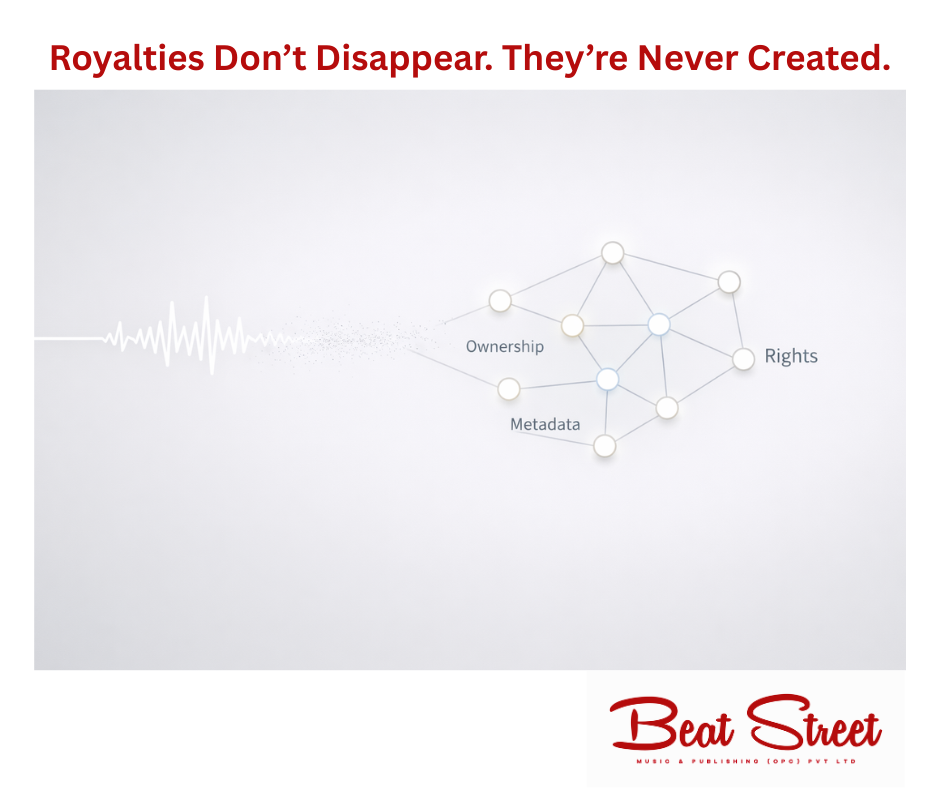
The system does not interpret. It processes.
Music rights systems are often misunderstood as being incomplete or delayed. In reality, they are extremely consistent in one aspect. They process what they are given.
They do not pause to question missing information.
They do not attempt to reconcile inconsistencies.
They do not infer ownership.
If a work enters the system without clarity, the system does not correct it. It simply continues without assigning value.
This is where most royalty loss begins.
Recognition Is Not automatic
For a piece of music to generate royalties, it first needs to be recognised across multiple layers.
The work needs to exist as a defined asset.
The contributors need to be consistently identified.
Ownership needs to be clearly established.
If any of these layers are weak or incomplete, the system does not fail loudly. It continues silently, without linking usage to the right owners.
Where the breakdown actually happens
The failure is rarely a single large mistake. It is usually a series of small gaps that compound over time.
A work may not be properly registered with a rights organisation.
Contributor information may vary across platforms, making it difficult to match the same individual across systems.
Ownership splits may remain informal or undocumented, leaving no clear basis for allocation.
In cases involving visual media, cue sheets may not be filed, or may be filed with incomplete information, disconnecting usage from ownership.
And in many instances, publishing is never activated at all, which means the composition layer remains unclaimed even when the recording is generating activity.
Each of these gaps appears minor in isolation. Together, they prevent the system from connecting usage to ownership.
The absence of friction is misleading
One of the reasons this problem goes unnoticed is because there is no visible error.
There are no alerts indicating that royalties are being lost.
There is no notification that a work was not recognised.
From the outside, everything appears to be functioning.
Usage happens. Content is distributed. Streams accumulate.
But underneath that activity, the connection required for value to flow may never have been established.
The point most people miss
Royalties are not something that are calculated first and disputed later.
They are the result of a system successfully linking three things:
a. A work
b. Its usage
c. Its ownership
If that link is not established at the beginning, there is nothing to calculate.
The conversation around royalties often focuses on recovery.
But recovery assumes that value was created and held somewhere.
In many cases, that is not what happened.
The system did not fail to pay.
It never recognised what needed to be paid.
And when recognition doesn’t happen at the start,
there is nothing left to recover.
Written by Amit Dubey
Founder, Beat Street Music & Publishing
Leave a Reply