Music is beginning to create value before ownership is even clear.
It does not begin with a release.
It does not depend on distribution.
And it is not always tied to a clearly identified creator.
It begins much earlier.
Inside training data.
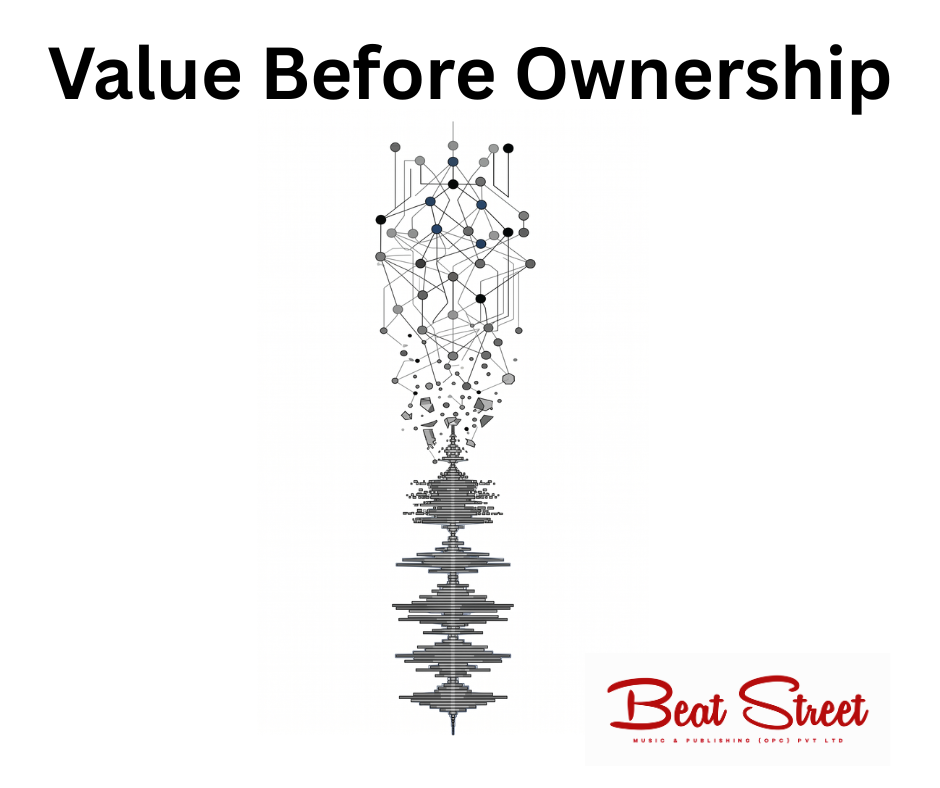
A composer gets a call.
Create music for AI training.
At first, it feels like work.
A new kind of project. A new opportunity.
But the question is not about the brief.
It is about what this work becomes once it leaves the room.
Because this is not just about creating music.
It is about contributing to a system that will learn from it, build on it, and generate from it repeatedly.
Training is invisible. Value is not.
This is where music stops behaving only like content and starts behaving like infrastructure.
When music is used for training, nothing is publicly visible.
No release.
No credits.
No metadata trail.
But the system learns.
Patterns.
Structures.
Styles.
And that learning does not stay contained.
It shows up later in generated outputs.
Outputs that carry influence, but not attribution.
Outputs exist without clear ownership
AI platforms often allow users to generate music and use it.
In some cases, they even assign rights to the user.
But there is a consistent pattern.
They stop short of guaranteeing ownership.
Because the nature of how these outputs are created makes that difficult to define.
If multiple sources, influences, and training data points contribute to a result,
then authorship is no longer a clean line.
It becomes a blend.
And blends are hard to own.
Royalties have no starting point
In traditional systems, royalties follow structure.
A work is created.
Ownership is defined.
Usage is tracked.
Value is distributed.
Here, that sequence breaks.
If there is no clear author,
and no clear ownership,
then where does royalty begin?
At generation?
At usage?
At distribution?
Or not at all?
Copyright was not designed for this
Most copyright frameworks, including in India, are built on a simple premise.
A human creates a work.
That work can be identified, owned, and protected.
AI challenges each part of that premise.
Creation becomes collaborative in ways that are not visible.
Authorship becomes diffused.
Ownership becomes uncertain.
The system was not designed for this kind of input.
And it shows.
What this really is
This is not just a legal question.
It is a structural one.
Music is no longer only being created.
It is being used to build systems that will create more music.
Value is no longer generated once.
It is generated repeatedly, often without a clear link back to the source.
AI is not just changing how music is made.
It is changing when value begins, how ownership is interpreted, and whether attribution can keep up.
The music industry has spent decades building systems around identifiable works and identifiable creators.
AI challenges both.
And right now, value is moving faster than the systems designed to recognise it.
AI is accelerating value creation in ways existing rights systems were never built to fully interpret.
And until those systems evolve, attribution, ownership, and monetisation will remain increasingly difficult to align.
Written by: Amit Dubey
Founder, Beat Street Music & Publishing
Leave a Reply