The music industry is currently busy debating one question:
Can AI legally train on music?
It is an important conversation.
Consent, licensing, compensation, and ownership are all valid concerns.
But focusing only on copyright risks missing a much larger operational problem hiding in plain sight.
AI music is not only testing copyright law.
It is stress testing the infrastructure of the music business itself.
And that infrastructure was already under pressure long before AI entered the conversation.
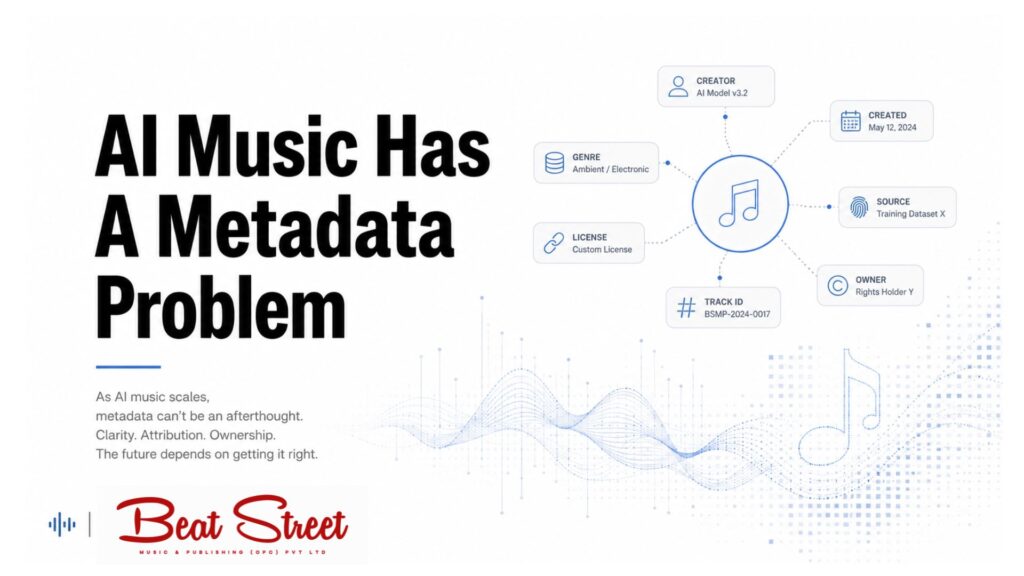
The Real Bottleneck Is Not Creation
Music creation is no longer the bottleneck.
A song can now be generated, edited, versioned, adapted, localized, remixed, and distributed faster than ever.
This changes the economics of scale.
Not because music suddenly became easier to create.
But because the volume of music entering the ecosystem can now multiply significantly.
More tracks.
More alternate versions.
More stems.
More adaptations.
More derivative works.
More catalog noise.
The industry is not just facing an AI problem.
It is facing a scale problem.
And scale exposes operational weakness.
Metadata Was Already a Weak Link
Before AI, the industry was already dealing with persistent metadata issues.
Missing writer credits.
Incorrect ownership percentages.
Inconsistent contributor names.
Unregistered works.
Improper identifiers.
Fragmented rights information across territories and systems.
These issues may seem administrative during release.
But they often become financial problems later.
A missing split conversation today can become a royalty conflict tomorrow.
An incorrect metadata field today can lead to unmatched usage later.
A delayed registration can push earnings further into uncertainty.
None of this is new.
AI simply increases the cost of getting these things wrong.
AI Makes Attribution More Important, Not Less
As music generation scales, attribution becomes central.
Not optional.
If a single human-led release already struggles with ownership accuracy, imagine the complexity introduced by:
- AI-assisted compositions
- Multiple prompts and iterations
- Human edits layered over generated material
- Versioning across languages, markets, and formats
- Reuse of motifs, stems, and structures at scale
This is where the conversation becomes larger than copyright.
The real operational question is:
How will the industry track ownership, attribution, permissions, and downstream usage when music creation becomes infinitely scalable?
Without clear attribution architecture, the industry risks building scale without traceability.
And scale without traceability is where royalty leakage accelerates.
Royalty Systems Depend on Structured Information
Royalties do not flow because music exists.
Royalties flow because systems can identify:
- Who owns what
- In what proportion
- In which territories
- Across which rights
- Against which usage data
This depends heavily on structured information.
Metadata is not decorative.
It is transactional infrastructure.
When metadata fails, monetisation slows, fragments, or disappears.
In an AI-heavy environment, this risk compounds.
Not because AI is inherently harmful.
But because higher output volume magnifies operational inefficiency.
The Industry May Need New Infrastructure, Not Just New Law
The conversation around AI in music often defaults to regulation.
And regulation matters.
But regulation alone will not solve attribution chaos.
The industry may also need stronger operational standards around:
- AI training permissions
- Attribution frameworks
- Metadata enrichment
- Rights documentation
- Ownership verification workflows
Without this, the gap between music creation and music monetisation will continue to widen.
What Comes Next
The future music economy may not only reward those who create the fastest.
It may increasingly reward those who can prove:
- Ownership
- Attribution
- Permissions
- Usage trail
- Revenue entitlement
with the highest degree of clarity.
AI is not just challenging copyright.
It is revealing how dependent the future of music monetisation is on information quality.
The industry may discover that before solving AI governance, it first needs to solve something more fundamental:
the ability to track music ownership and attribution with far greater precision than it does today.
Written by: Amit Dubey
Founder, Beat Street Music & Publishing
Leave a Reply