Every music business wants to make informed decisions.
More data.
More evidence.
More market validation.
More certainty.
That instinct makes sense.
But some of the most valuable opportunities in music have an uncomfortable characteristic.
They often become obvious only after much of the advantage has disappeared.
An emerging artist looks less risky once the audience is visible.
A catalogue looks more attractive once renewed demand becomes measurable.
A new market looks promising once growth has already accelerated.
A cultural shift becomes easier to recognise once everyone is talking about it.
By then, the opportunity still exists.
But so does the competition.
That creates one of the hardest questions in business:
How much evidence is enough to act?
The Certainty Paradox
Businesses naturally prefer certainty.
Investment committees want evidence.
Marketing teams want audience signals.
Acquirers want historical performance.
Leadership teams want confidence before committing resources.
But opportunity and certainty do not always arrive at the same time.
Often, they move in opposite directions.
As certainty increases, risk may decline.
But so can the advantage of acting early.
The artist attracts more bidders.
The catalogue becomes more expensive.
The market becomes more crowded.
The opportunity becomes visible to everyone else.
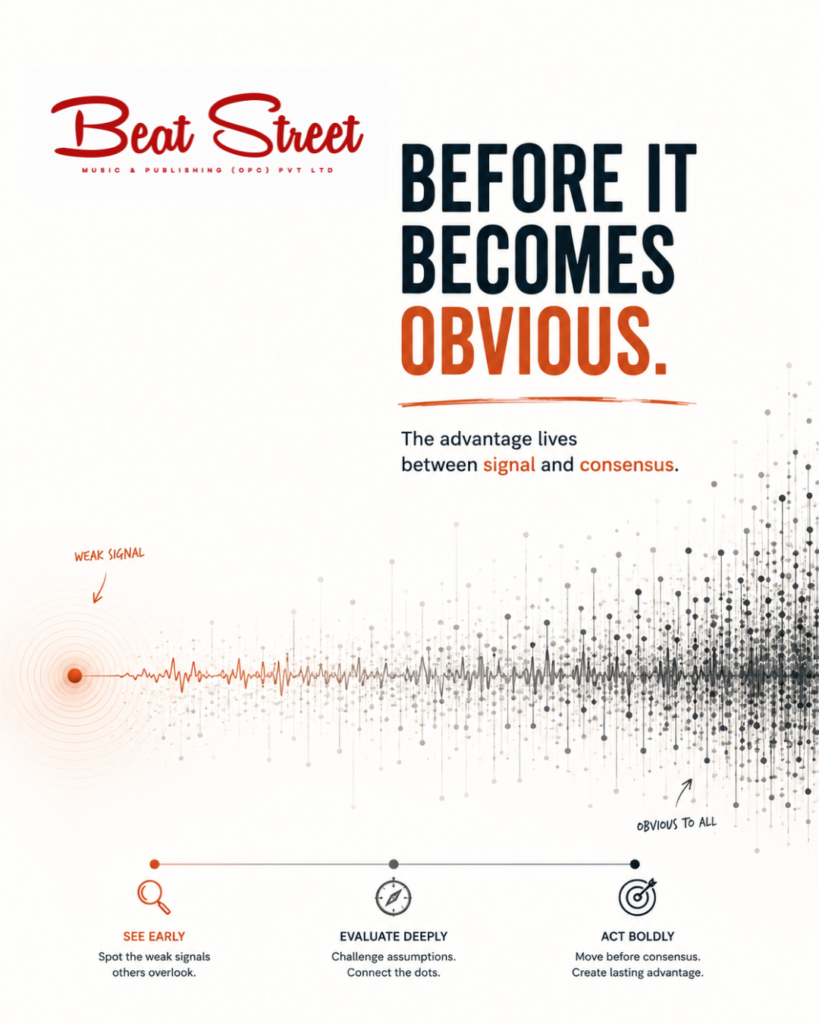
This creates what might be called the Certainty Paradox:
Businesses want certainty before they act. But certainty is often what removes the advantage.
The Earliest Signals Rarely Look Convincing
The difficulty is that opportunities rarely announce themselves as opportunities.
They begin as weak signals.
A song unexpectedly gaining traction in one territory.
An older recording being rediscovered by a younger audience.
A small but unusual change in listener behaviour.
A new licensing category beginning to emerge.
An artist connecting deeply with a relatively small audience.
None of these signals necessarily justify immediate investment.
Most may lead nowhere.
But occasionally, one represents the beginning of something much larger.
The challenge is recognising which deserves attention before the evidence becomes overwhelming.
Data Helps. It Cannot Remove Uncertainty.
Modern music businesses have extraordinary visibility.
Streaming analytics can identify audience behaviour.
Social platforms reveal cultural momentum.
AI can detect patterns across enormous datasets.
Market intelligence can compare performance across artists, catalogues and territories.
All of this improves decision-making.
But no amount of information can completely eliminate uncertainty about the future.
Data can tell us what is happening.
It can help us understand why something may be happening.
It can even suggest what could happen next.
But eventually, someone still has to make a call.
Wait for more evidence.
Or act.
That gap between evidence and action is where conviction begins.
Conviction Is Not Instinct Without Evidence
Acting early does not mean acting recklessly.
There is an important difference between conviction and speculation.
Speculation acts without adequately understanding the evidence.
Conviction interprets incomplete evidence and accepts that certainty may never arrive in time.
Strong decision-makers do not simply ask:
Do we have enough information?
They also ask:
What would we need to believe for this opportunity to be worth pursuing?
And perhaps more importantly:
What will this opportunity look like if everyone else reaches the same conclusion six months from now?
That changes the nature of the decision.
The objective is no longer to eliminate uncertainty.
It is to understand whether the potential advantage justifies acting before uncertainty disappears.
Waiting Is Also A Decision
Businesses often think of waiting as the safer option.
Sometimes it is.
But waiting carries its own risk.
The artist may sign elsewhere.
The catalogue may attract another buyer.
The audience moment may pass.
The licensing opportunity may become crowded.
The cost of entry may increase.
Doing nothing does not preserve the original opportunity indefinitely.
Time changes it.
This is why the cost of waiting should be considered alongside the risk of acting.
Not every early signal deserves investment.
But neither should every decision wait for overwhelming proof.
The Advantage Exists Before Consensus
The music business will continue to become better informed.
More analytics.
More predictive technology.
More AI.
More sophisticated market intelligence.
That will help businesses identify opportunities faster.
But it will also help everyone else identify them faster.
Which means information alone may not create lasting advantage.
The advantage may increasingly exist in the period between signal and consensus.
When something is visible.
But not yet obvious.
When there is evidence.
But not certainty.
When acting still requires conviction.
Because once everyone can see the opportunity, recognising it is no longer the advantage.
Acting before consensus may be.
Written by: Amit Dubey, Founder, Beat Street Music & Publishing, Music Business Strategist
Leave a Reply