Every music business knows what its catalogue earned last year.
Monthly streaming revenue.
Publishing royalties.
Sync income.
Neighbouring rights.
Catalogue growth.
Those numbers matter.
But they tell only one side of the story.
The bigger question is rarely asked.
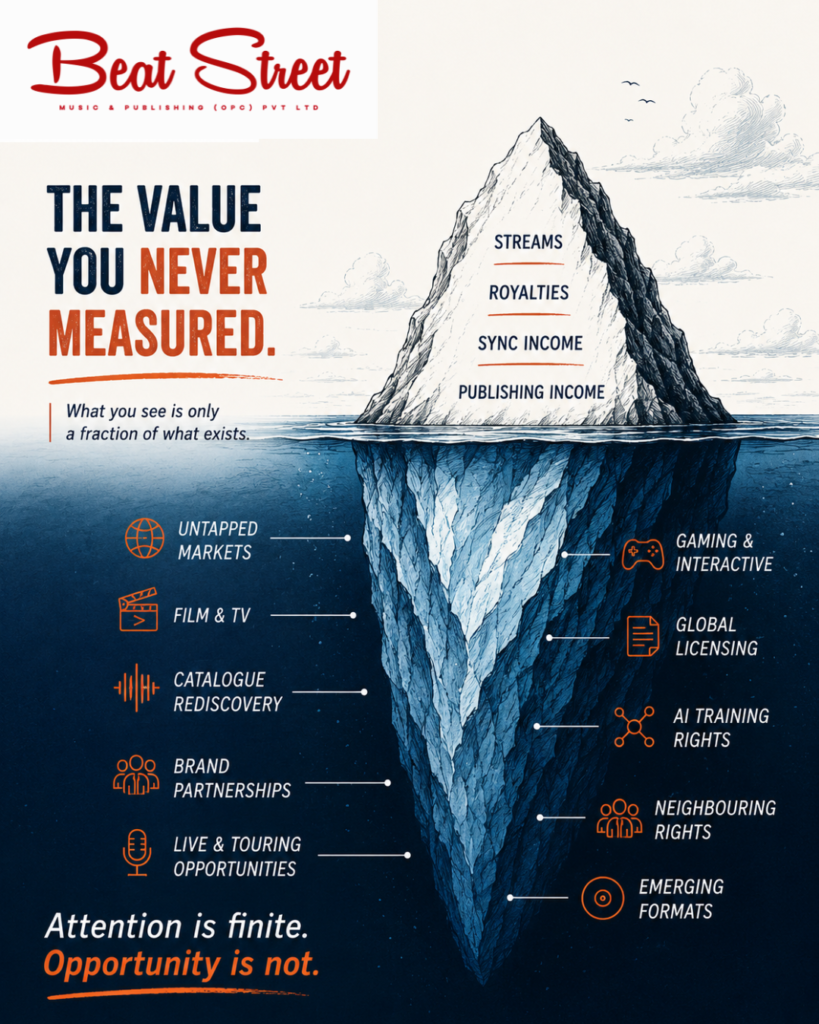
How much value did your catalogue never have the opportunity to create?
Not because the music lacked quality.
But because commercial potential was never recognised.
Never prioritised.
Never pursued.
Economists call this opportunity cost.
The music business rarely measures it.
Yet it may shape long-term catalogue value more than many of the numbers we track every month.
The New Scarcity
For decades, music companies competed by discovering better artists and creating better music.
Today, great music has become more abundant than ever.
Streaming has removed barriers to distribution.
Independent artists can reach global audiences.
Artificial intelligence is accelerating creation even further.
Scarcity has moved.
For years, music was the scarce resource.
Today, commercial attention is.
Not consumer attention.
Commercial attention.
The attention required to recognise opportunity before it disappears.
Every catalogue is competing for the same finite pool of commercial attention.
The challenge is no longer creating another song.
It is recognising which existing song deserves the next commercial decision.
That is the modern bottleneck.
Every Song Is Competing for a Decision
As catalogues grow, every commercial decision becomes an allocation decision.
Should this song receive additional marketing support?
Should that recording be pitched for sync?
Should an older work be introduced into a new territory?
Should resources be invested in a catalogue campaign or a new release?
Should a forgotten recording be reintroduced to a new audience?
Every choice to pursue one opportunity means another waits.
Sometimes that is the right decision.
Sometimes it quietly becomes the most expensive decision the business never knew it had made.
Because opportunity cost rarely appears on a royalty statement.
The Revenue Nobody Measures
Unlike realised revenue, unrealised opportunity leaves almost no evidence.
A catalogue track that was never pitched.
A regional hit that never reached another market.
A sync opportunity lost because ownership information was not immediately available.
A catalogue review that never happened because attention remained focused on new releases.
An artist partnership that began too late.
None of these appear in financial reports.
Yet collectively, they may represent some of the largest unrealised value sitting inside a music business.
The absence of revenue is difficult to quantify.
That does not make it commercially insignificant.
Opportunity Is a Management Discipline
Every catalogue contains more commercial possibilities than any team can realistically pursue.
Not every opportunity deserves investment.
But every opportunity deserves consideration.
That distinction is becoming increasingly important.
The businesses creating long-term value are often not those with the biggest catalogues.
They are the ones with better systems for identifying, prioritising and acting on commercial opportunities before they disappear.
The challenge is no longer discovering opportunity.
It is discovering opportunity before competitors do, or before the moment passes.
Timing is increasingly becoming part of catalogue strategy.
Increasingly, catalogue management is becoming asset management.
And asset management is fundamentally about making better decisions.
The Next Competitive Advantage
For years, competitive advantage came from discovering great music before everyone else.
Increasingly, it may come from recognising the unrealised value already sitting inside the music you already own.
Every catalogue contains unrealised commercial opportunities.
The question is not whether they exist.
The question is whether the business recognises them before they disappear.
The businesses that learn to allocate commercial attention more effectively may ultimately outperform businesses with much larger catalogues.
Because creating music creates assets.
Recognising opportunity creates value.
Over the next decade, that difference may quietly become one of the industry’s most sustainable competitive advantages.
—
Written by: Amit Dubey, Founder, Beat Street Music & Publishing, Music Business Strategist
Leave a Reply