Every year, the music business becomes better informed.
More streaming data.
More audience analytics.
More royalty reports.
More metadata.
More AI.
More dashboards.
More market intelligence.
By almost every measure, the industry has access to more information than ever before.
Yet businesses continue to miss opportunities.
Catalogues remain underutilised.
Sync opportunities disappear.
Marketing budgets are misallocated.
This raises an uncomfortable question.
If the industry has more information than ever before, why aren’t commercial decisions improving at the same pace?
Perhaps because information is no longer the constraint.
Judgement is.
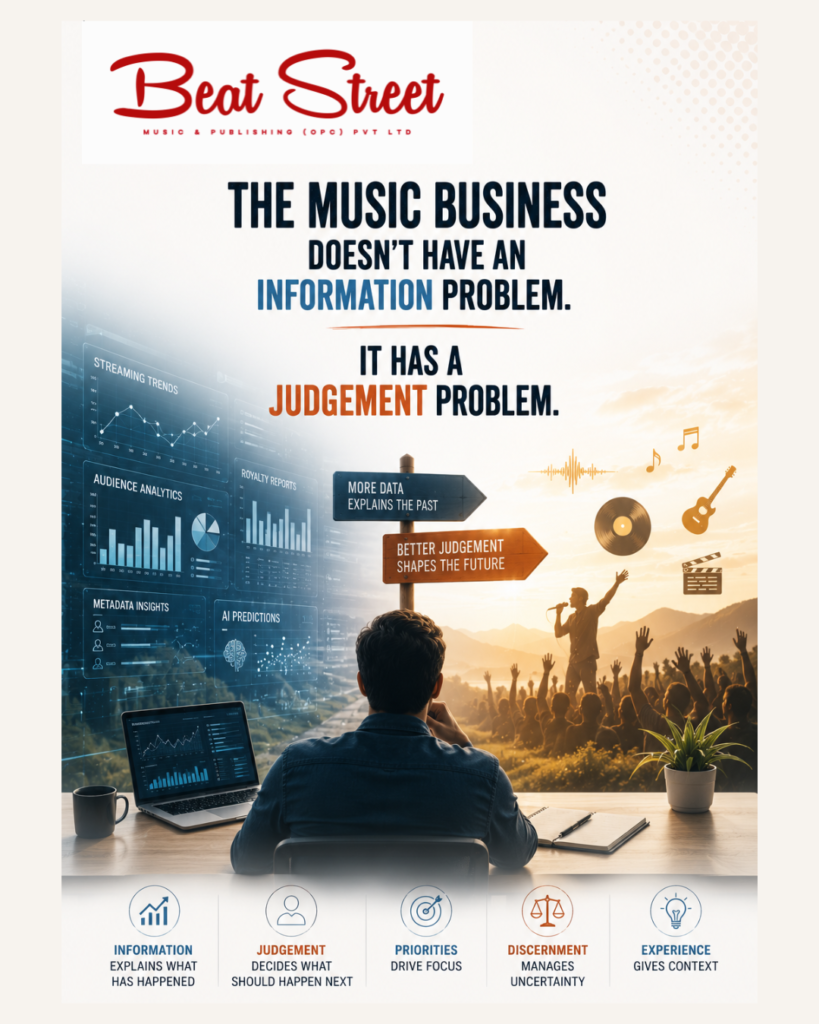
The Information Plateau
Every growing business eventually reaches a point where collecting more information produces diminishing returns.
Additional dashboards reveal another trend.
Another report identifies another audience segment.
Another AI tool predicts another possibility.
Information continues to grow.
Decision quality does not.
I increasingly think many organisations eventually reach what could be called the Information Plateau.
The point at which more information stops producing proportionately better commercial decisions.
Think about the last decade.
Music businesses have invested heavily in streaming analytics, audience intelligence, reporting tools and artificial intelligence.
Yet the industry’s biggest commercial questions remain remarkably similar.
Which artists deserve long-term investment?
Which catalogues should be acquired?
Which songs deserve another chance?
More information has improved visibility.
It has not eliminated uncertainty.
That is what makes the Information Plateau so significant.
The constraint has shifted.
Not from information to technology.
But from information to judgement.
Information Doesn’t Create Strategy
Most music businesses already know what is happening.
They know which songs are streaming.
Which territories are growing.
Which playlists are performing.
Which releases generated revenue.
The harder question is no longer what happened.
It is what should happen next.
Should resources be redirected?
Should an older catalogue receive investment?
Should a song be repositioned?
Should an acquisition proceed?
Should a catalogue remain untouched?
None of these decisions are made by dashboards.
They are made by people.
Judgement Thrives Where Certainty Ends
Judgement is not the ability to analyse more information.
It is the ability to decide despite uncertainty.
Every major commercial decision in the music business is made before complete certainty exists.
Whether to sign an artist.
Acquire a catalogue.
Invest in a campaign.
Enter a new market.
Delay a release.
The quality of those decisions rarely depends on having perfect information.
It depends on exercising sound judgement.
Information explains possibilities. Judgement creates priorities.
AI Will Increase The Gap
Artificial intelligence will dramatically increase the amount of information available to music businesses.
Predictions.
Recommendations.
Audience modelling.
Commercial forecasts.
Metadata enrichment.
Rights analysis.
This will make information cheaper than ever.
It will not make judgement easier.
In fact, it may make it harder.
Because more information often creates more possible decisions.
An AI platform may identify fifty songs that appear commercially promising.
It cannot decide which three deserve next quarter’s marketing budget.
That remains a judgement call.
The organisations that create the greatest long-term value will not necessarily have better technology.
They will have better judgement about when to trust the technology—and when not to.
Judgement Is Becoming The Competitive Advantage
For years, competitive advantage came from having access to better information.
Today, that advantage is disappearing.
The same streaming data is available to competitors.
The same AI tools are becoming widely accessible.
The same analytics platforms serve thousands of businesses.
Information is becoming democratised.
Judgement is not.
The organisations that consistently create value may not be those collecting the most data.
They may be those making the clearest commercial decisions when everyone has access to similar information.
The Next Generation Of Music Leaders
Leadership in the modern music business is changing.
The question is no longer:
Who has the best information?
It is increasingly:
Who consistently exercises the best judgement?
Because information explains what has happened.
Judgement decides what should happen next.
The future competitive advantage in the music business may not belong to those with the most information.
It may belong to those who consistently exercise the best judgement when everyone has access to the same information.
Because information has become abundant.
Judgement remains scarce.
Written by: Amit Dubey, Founder, Beat Street Music & Publishing, Music Business Strategist
Leave a Reply