A catalogue can generate millions in streams and still become difficult to license, finance, acquire, or monetise efficiently when the underlying rights infrastructure is unclear.
In today’s music economy, catalogues are now being treated as financial assets.
They are bought, sold, licensed, securitised, financed against future earnings, and evaluated for long term commercial potential.
But an asset is only as valuable as the systems that make it operationally trustworthy.
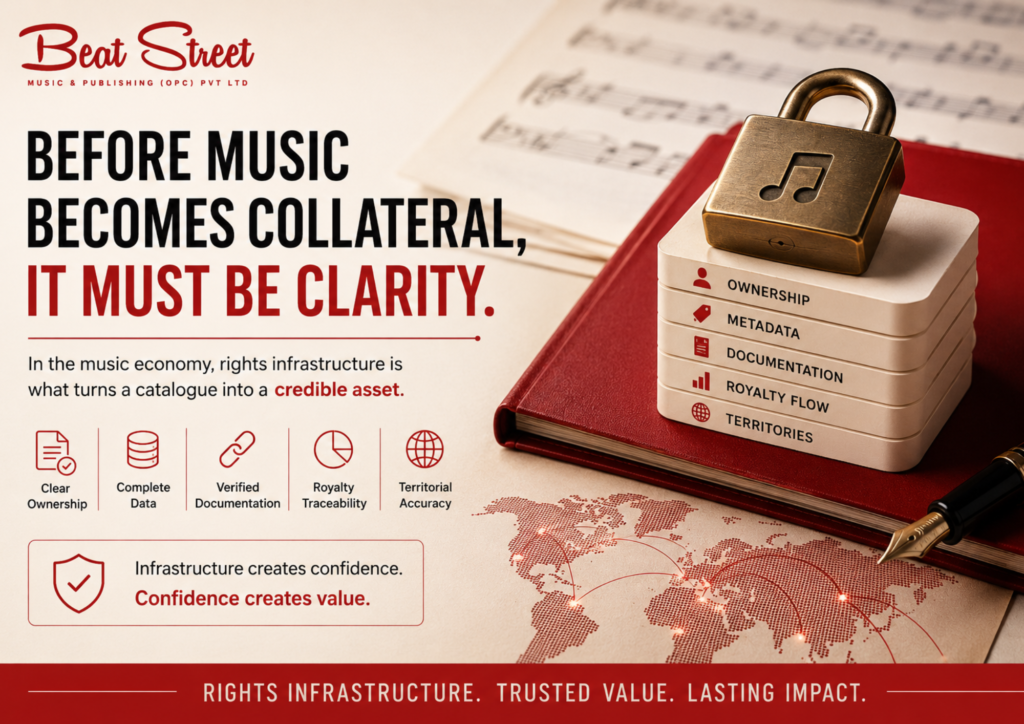
Before music becomes collateral, it must first become traceable.
Music is no longer only a creative output
For decades, songs were largely viewed through a creative and commercial lens.
Did the music connect?
Did it generate revenue?
Did it build an audience?
Those questions still matter.
But the conversation around music catalogues has evolved.
Today, music is also evaluated through another lens: asset quality.
Catalogues are no longer only creative outputs.
They are recurring revenue assets.
Recurring revenue assets are evaluated not only for what they earn, but for how reliably those earnings can continue across future licensing, publishing, collections, and monetisation environments.
This changes the definition of value.
A culturally successful catalogue may still introduce risk if ownership, documentation, metadata, or rights history remain fragmented underneath.
Cultural relevance may create demand.
Infrastructure determines whether that demand can scale efficiently.
What weakens catalogue value
A catalogue can appear commercially attractive on the surface and still contain significant friction underneath.
Common issues include:
- Unclear ownership chains
- Incomplete registrations
- Unresolved splits
- Missing agreements
- Inconsistent metadata
- Territorial conflicts
- Poor documentation history
A catalogue may have strong streaming performance, publishing activity, or licensing history and still become difficult to evaluate confidently during due diligence.
For example, a potential buyer or publishing partner may discover:
a) inconsistent songwriter data across territories
b) unresolved split disputes from earlier releases
c) missing agreements
d) incomplete chain of title documentation tied to commercially active works
The revenue may exist.
The certainty may not.
Financial markets reward predictability.
Rights ambiguity introduces risk.
Risk affects confidence.
Confidence affects valuation.
Valuation is rarely determined by revenue alone. It is also shaped by predictability.
Revenue history may create opportunity.
Rights clarity determines how investable that opportunity becomes.
Due diligence now includes infrastructure diligence
As catalogues become more financialised, due diligence is no longer limited to revenue performance alone.
It now includes infrastructure quality.
Buyers, investors, publishers, and strategic partners are evaluating not only earnings, but also:
- Ownership verification
- Documentation integrity
- Chain of title
- Royalty traceability
- Rights readiness
- Metadata consistency
- Administrative reliability
The music itself may be commercially valuable.
But if the systems underneath are fragmented, monetisation efficiency weakens.
Operational friction slows licensing.
Unresolved ownership delays exploitation.
Incomplete data affects collections.
Territorial inconsistencies complicate administration.
The commercial value of a catalogue is no longer determined solely by cultural relevance or streaming performance.
Operational readiness now plays a direct role in asset confidence.
AI makes rights infrastructure even more important
As AI licensing, synthetic content, training data usage, and digital rights ecosystems continue evolving, infrastructure quality becomes even more commercially important.
The industry is moving toward:
i. more licensing layers
ii. more rights stakeholders
iii. more contributors
iv. more versions
v. more metadata dependencies
vi. more cross platform usage environments
In that ecosystem, rights clarity becomes more than an administrative requirement.
It becomes a scalability requirement.
The future value of music may depend as much on infrastructure readiness as creative relevance.
The conversation is no longer only about ownership.
It is also about operational trust.
Catalogue value is built on clarity
Catalogue value is not determined by streams alone.
It is shaped by:
i. ownership clarity
ii. data clarity
iii. documentation clarity
iv. royalty visibility
v. commercial readiness
As music becomes increasingly financialised, rights infrastructure is no longer back office administration.
It is part of asset quality itself.
In the next decade of the music business, the strongest catalogues may not simply be the most streamed.
They may be the most operationally trustworthy.
Before music becomes collateral, it must first become operationally investable.
Written by
Amit Dubey
Founder, Beat Street Music & Publishing
Leave a Reply