The music industry often frames its biggest challenges around royalties.
Low payouts.
Delayed payments.
Licensing disputes.
Ownership conflicts.
Unclaimed revenue.
But many of these problems do not begin at the point of payment.
They begin much earlier.
At the point where memory starts breaking down.
Not human memory.
Institutional memory.
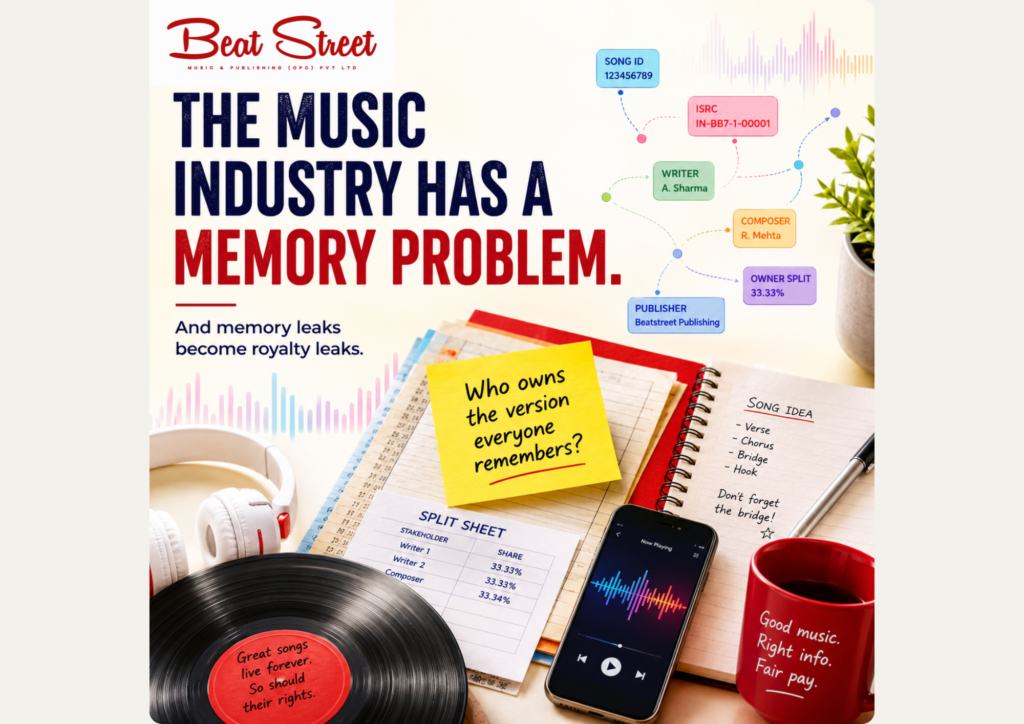
Because modern music does not exist only as songs anymore.
It exists as a constantly evolving network of:
- metadata,
- identifiers,
- ownership structures,
- licensing rights,
- publishing claims,
- recording versions,
- distribution pipelines,
- territorial rights,
- and platform relationships.
And unlike physical assets, music compounds silently over time.
A song released today may continue generating commercial value for decades across streaming, sync, short-form content, performance rights, publishing income, catalogue licensing, and future reinterpretations.
But for that value to travel correctly through the ecosystem, the industry must continue remembering:
- who created the work,
- who owns which rights,
- which agreement supersedes another,
- which version is commercially active,
- how splits evolved over time,
- and how the asset moved across platforms and partners.
This is where things quietly begin to fracture.
A split sheet goes missing.
A recording is uploaded with inconsistent metadata.
An ISRC is incorrectly mapped.
A catalogue migrates between systems.
A rights holder changes.
A legacy agreement becomes difficult to trace.
A regional release enters the ecosystem without operational consistency.
None of these issues appear dramatic individually.
But collectively, they shape the long-term economic integrity of music assets.
Years later, the commercial consequences become visible:
- royalty mismatches,
- ownership disputes,
- delayed exploitation opportunities,
- reconciliation complexities,
- and catalogue valuation challenges.
Yet by then, the original operational error is often difficult to identify.
Because music businesses rarely lose value suddenly.
Value erodes gradually through fragmented memory.
This is one of the least discussed realities of the modern music ecosystem:
royalty leakages are often memory leakages first.
The industry still tends to treat infrastructure as secondary to creativity.
But increasingly, infrastructure is becoming part of the value itself.
A catalogue today is not merely a collection of songs.
It is a living rights architecture.
Its long-term value depends not only on cultural relevance, but also on:
- traceability,
- documentation,
- attribution integrity,
- metadata continuity,
- and operational discipline across time.
This becomes even more significant as music catalogues increasingly behave like financial assets.
Across the global industry, catalogues are now being acquired, financed, licensed, securitised, and evaluated through long-term revenue projections.
But an asset can only scale sustainably when the underlying ownership infrastructure remains clear.
Because songs often outlive the systems that originally released them.
Teams change.
Distributors evolve.
Formats disappear.
Platforms consolidate.
Rights move across entities.
Metadata standards shift.
Yet the expectation remains unchanged:
that ownership and monetisation should continue functioning seamlessly across decades.
This is why documentation can no longer be viewed as administrative overhead.
Metadata is no longer back-office support.
Rights infrastructure is no longer optional operational hygiene.
It is becoming core asset infrastructure.
A hit song may create attention.
But structured ownership creates durability.
And in the years ahead, the companies that preserve memory well may ultimately become the companies that preserve value best.
Because in modern music, ownership is not only legal. It is operational.
Written by: Amit Dubey
Founder, Beat Street Music & Publishing
Leave a Reply