For decades, the music business has been built around a relatively simple question:
Who owns the rights?
Ownership determines who gets paid, who can license a work, who can enforce rights, and who controls commercial decisions.
Entire industries have been built around answering that question.
Publishers.
Record labels.
Collective management organisations.
Rights administrators.
Lawyers.
Royalty systems.
But as artificial intelligence becomes increasingly embedded in the creative process, another question is beginning to emerge.
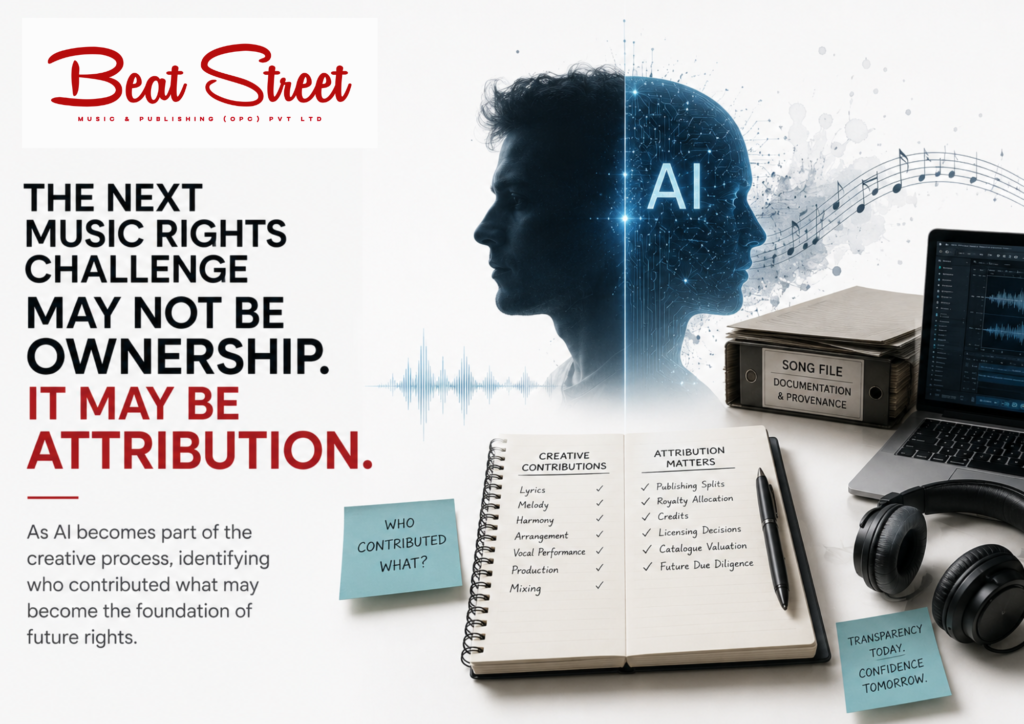
Who contributed what?
At first glance, ownership and attribution may seem like the same issue.
They are not.
Ownership determines legal rights.
Attribution determines how creative contributions are identified, documented, and recognised.
And without reliable attribution, ownership itself can become difficult to establish.
Consider how music creation is evolving.
A songwriter may use AI to generate lyrical ideas.
A producer may use AI-generated samples.
An artist may use AI-assisted tools for arrangement, mixing, or vocal experimentation.
A composer may use generative systems to explore melodies before refining them into a final work.
In many of these situations, there is still meaningful human creativity involved.
But the creative process becomes less straightforward than the traditional model where identifiable individuals contributed clearly defined elements to a song.
The challenge is not necessarily determining whether a copyright exists.
The challenge is understanding how the work came into existence in the first place.
That distinction matters because rights systems depend on attribution.
Publishing splits depend on attribution.
Royalty allocations depend on attribution.
Credits depend on attribution.
Licensing decisions depend on attribution.
Even catalogue valuations depend on understanding the underlying rights associated with a work.
Historically, attribution has often been treated as an administrative exercise.
In an AI-assisted creative environment, it may increasingly become a strategic exercise.
Something handled after creation.
A form to complete.
Metadata to submit.
Credits to finalise.
But AI may force the industry to think differently.
The more complex the creative process becomes, the more important attribution becomes at the point of creation rather than after the fact.
The issue extends beyond copyright.
Imagine a catalogue acquisition five years from now.
A buyer discovers that a meaningful percentage of commercially successful works were created using multiple AI-assisted tools, but no consistent record exists regarding how those tools were used or where human contributions began and ended.
The legal position may remain unclear.
But the commercial uncertainty could still influence valuation, due diligence, and investor confidence.
Similarly, music supervisors, brands, platforms, investors, and catalogue buyers may increasingly seek transparency around creative provenance.
Not because attribution replaces ownership.
But because attribution may become one of the foundations upon which ownership claims are evaluated.
A future catalogue transaction may not simply involve reviewing agreements and ownership records.
It may also involve evaluating how confidently creative contributions can be evidenced.
The stronger that confidence, the lower the uncertainty surrounding future exploitation, enforcement, and valuation.
This is why the conversation around AI and music should not focus exclusively on whether machines can create.
The more practical challenge may be whether the industry can continue to identify, document, and verify creative contributions as creation becomes more technologically assisted.
For years, music rights infrastructure has been designed to answer ownership questions.
The next generation of rights infrastructure may need to answer attribution questions as well.
Because ownership may remain the destination.
But attribution could become the evidence required to get there.
And in an increasingly AI-assisted music economy, that may become one of the most important rights challenges of the decade.
—
Written by: Amit Dubey, Founder, Beat Street Music & Publishing
Leave a Reply