The music industry has never produced more music than it does today.
Every day, thousands of new recordings appear on streaming platforms. Independent artists can release music globally with just a few clicks. Artificial intelligence is accelerating creation even further.
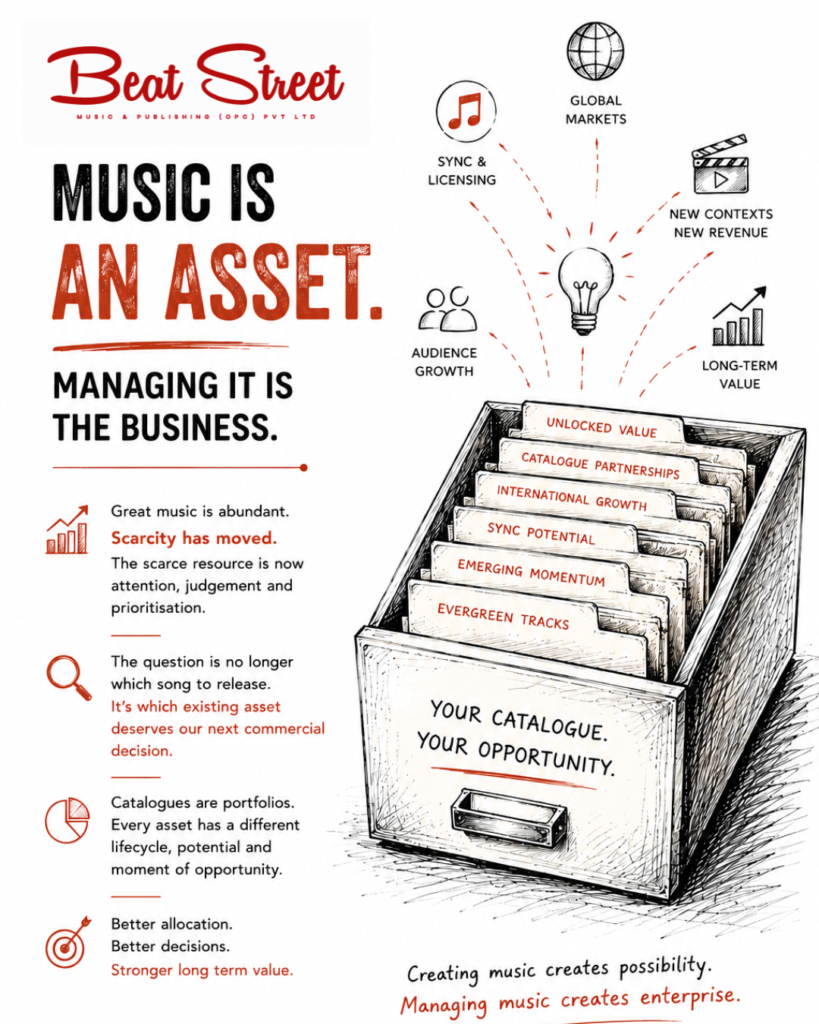
Music is no longer scarce. Attention, resources and execution are.
Yet many music businesses continue to struggle.
Not because they lack music.
Because they struggle to manage the assets they already own.
For decades, competitive advantage came from discovering great music before everyone else.
Finding the next artist.
Signing the next songwriter.
Releasing the next hit.
That equation has changed.
Great music has become more accessible than ever. What has become scarce is the ability to identify, prioritise and continually create value from an ever-growing portfolio of music assets.
Every new release creates another commercial decision.
Should it be actively marketed?
Should it be pitched for sync?
Should it be introduced to new markets?
Or is another song now a better investment?
As catalogues grow, the challenge is no longer simply creating music.
It is deciding where attention, time and investment should go.
That is fundamentally an asset management challenge.
Every catalogue eventually reaches a point where adding another song creates less value than making better decisions about the songs already inside it.
Consider a catalogue containing five thousand songs.
Like most investment portfolios, a small percentage of assets typically generates a disproportionate share of returns.
Some will quietly grow over time.
Others will find new audiences years after release.
Some may suddenly become relevant because of a cultural moment, a social media trend or a sync placement.
Most will simply sit there, waiting for someone to recognise their next commercial opportunity.
The value often already exists.
The question is whether anyone is actively looking for it.
This is one reason music catalogues increasingly resemble investment portfolios.
Every asset has a different lifecycle.
Some consistently generate returns.
Some decline.
Some outperform expectations years after everyone stopped paying attention.
Managing a catalogue is no longer simply about maintaining rights information. It is about making better commercial decisions throughout the life of every asset.
Every decision to promote one song instead of another is ultimately a capital allocation decision. Whether the investment is marketing budget, sync outreach, playlist pitching or management attention, resources are always finite. The businesses that consistently outperform are often those making better allocation decisions, not necessarily those owning the largest catalogues.
Artificial intelligence only reinforces this reality.
If AI enables the industry to create significantly more music, the bottleneck simply moves elsewhere.
Scarcity is no longer content.
Scarcity is attention, judgement and execution.
Businesses will not struggle to find music.
They will struggle to decide which music deserves commercial attention.
In many ways, the future advantage will not belong to the companies releasing the most music.
It will belong to those making better decisions about the music they already control.
This is already influencing how investors think about the industry.
Music catalogues are no longer viewed solely as collections of songs.
They are increasingly viewed as portfolios of intellectual property whose long-term value depends on how effectively they are managed, developed and commercialised.
Historical earnings remain important.
Future potential matters even more.
Not every opportunity announces itself.
Many begin quietly.
An unexpected increase in streaming.
Renewed listener interest in an older recording.
A regional audience discovering forgotten repertoire.
A creator using a catalogue track in a new context.
Signals like these often appear long before businesses recognise that an asset has entered a new phase of its commercial life.
The businesses paying attention recognise these moments for what they are.
Not anomalies.
Opportunities.
Perhaps that is the biggest shift taking place in the modern music business.
For years, success depended on finding great music.
Increasingly, success depends on recognising the value that already exists and having the discipline to unlock it.
The music industry will always be powered by creativity.
But as the industry becomes larger, faster and increasingly data-driven, the businesses that outperform may not be those creating the most assets.
They may simply be the ones that understand the assets they already own better than everyone else.
Because creating an asset is only the beginning.
Knowing when to invest in it, when to reposition it, when to license it and when to let it compound is where long-term value is created.
Written by: Amit Dubey, Founder, Beat Street Music & Publishing
Leave a Reply