The music business has always celebrated visible success.
The hit single.
The viral moment.
The sold out tour.
The catalogue acquisition.
The award.
These moments deserve to be celebrated. They define careers, shape reputations and generate headlines.
But they can also distract us from a quieter reality.
Most music businesses do not scale because they create more songs.
They scale because they build better systems.
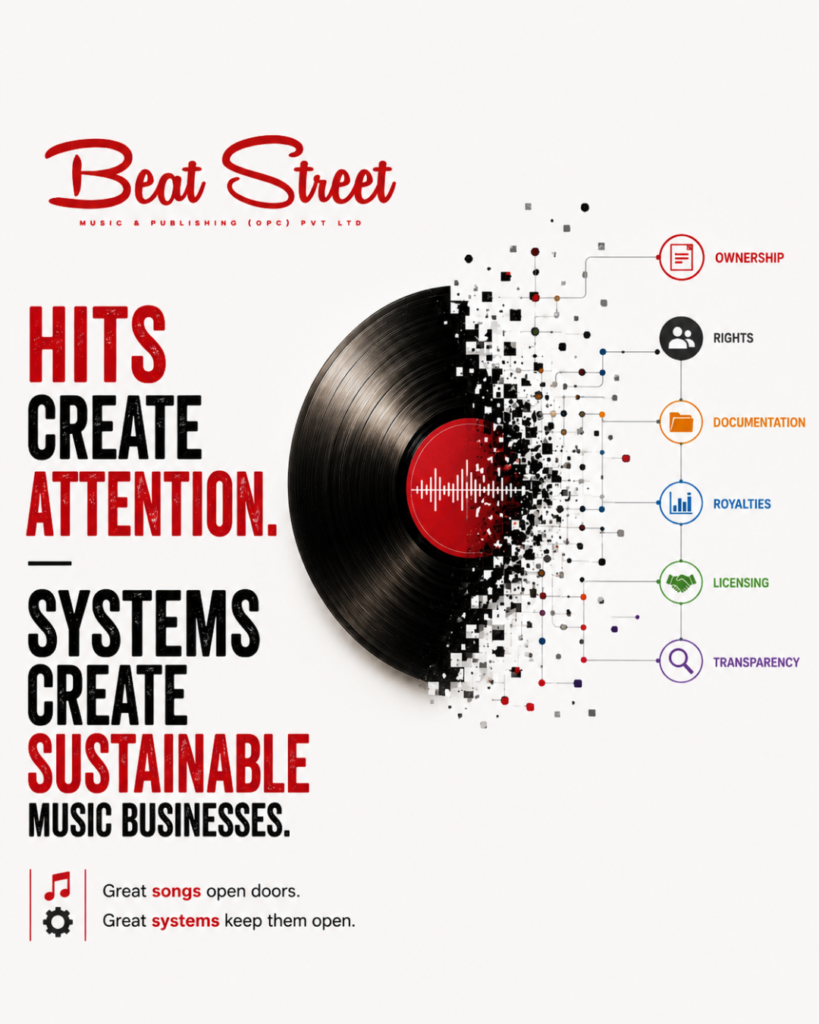
Every successful music business eventually reaches a point where creativity alone is no longer enough.
Growth has an interesting side effect.
Every new opportunity introduces another operational decision.
Another collaborator.
Another agreement.
Another rights holder.
Another registration.
Another revenue stream.
Success doesn’t reduce complexity.
It multiplies it.
And without the right operational foundations, growth that once felt exciting can gradually become friction.
Technology has transformed how music is created.
Global distribution has transformed how music is discovered.
Artificial intelligence is transforming how quickly music can be produced.
Creating more music has never been easier.
Managing more music has never been harder.
Twenty years ago, building a music business was largely a distribution challenge.
Today, distribution is often the easiest part.
The harder question is what happens after the music reaches the world.
Who owns it?
Who can license it?
Who collects from it?
Who can verify it?
Who can commercialise it quickly when opportunity arrives?
That is where competitive advantage is increasingly shifting.
For years, success depended on access.
Access to studios.
Access to distribution.
Access to audiences.
Today, advantage increasingly comes from execution.
The businesses that consistently outperform are rarely those creating the most music.
They are the ones that can onboard catalogues efficiently, license quickly, resolve rights questions without delay, process royalties accurately, and respond to commercial opportunities without unnecessary operational bottlenecks.
That is operational leverage.
Imagine two music catalogues generating identical annual revenue.
The first has organised agreements, verified ownership records, accurate registrations, documented creative contributions and a clear licensing history.
The second has incomplete documentation, conflicting ownership information, outdated registrations and unresolved administrative issues accumulated over several years.
On a spreadsheet, both appear equally valuable.
In a boardroom, they are very different assets.
One enables decisions.
The other delays them.
A music supervisor waiting for ownership confirmation may simply move on to another song.
A catalogue buyer may extend due diligence.
An investor may apply a lower valuation to reflect uncertainty.
A licensing opportunity may disappear because the business could not respond quickly enough.
None of those outcomes happen because the music is weaker.
They happen because execution is weaker.
This is where friction quietly shapes commercial outcomes.
Every unresolved ownership question introduces friction.
Every missing agreement creates friction.
Every manual process introduces friction.
Sometimes that friction lasts a few hours.
Sometimes it lasts for years.
These costs rarely appear on a financial statement.
Yet they influence licensing activity, catalogue valuation, investment decisions and long-term profitability.
Every successful music company eventually becomes an infrastructure company, whether it planned to or not.
As the music business becomes more global and increasingly interconnected, operational capability is becoming a competitive advantage in its own right.
Investors are no longer evaluating catalogues solely on historical earnings.
They are increasingly evaluating whether those earnings can be sustained, expanded and commercialised efficiently.
Licensees value speed alongside creativity.
Partners value clarity alongside opportunity.
Artificial intelligence will almost certainly accelerate the creation of music.
That makes operational capability even more valuable.
The businesses that succeed over the next decade may not simply be those creating the most content.
They will be the ones best equipped to manage, commercialise and scale that content across an increasingly complex global ecosystem.
Perhaps the future of the music business will not be defined by the biggest catalogue.
It may be defined by the business best prepared to unlock the full value of the catalogue it already owns.
Because great songs create opportunities.
Great systems unlock them.
Attention is temporary.
Infrastructure compounds.
Written by: Amit Dubey, Founder, Beat Street Music & Publishing
Leave a Reply