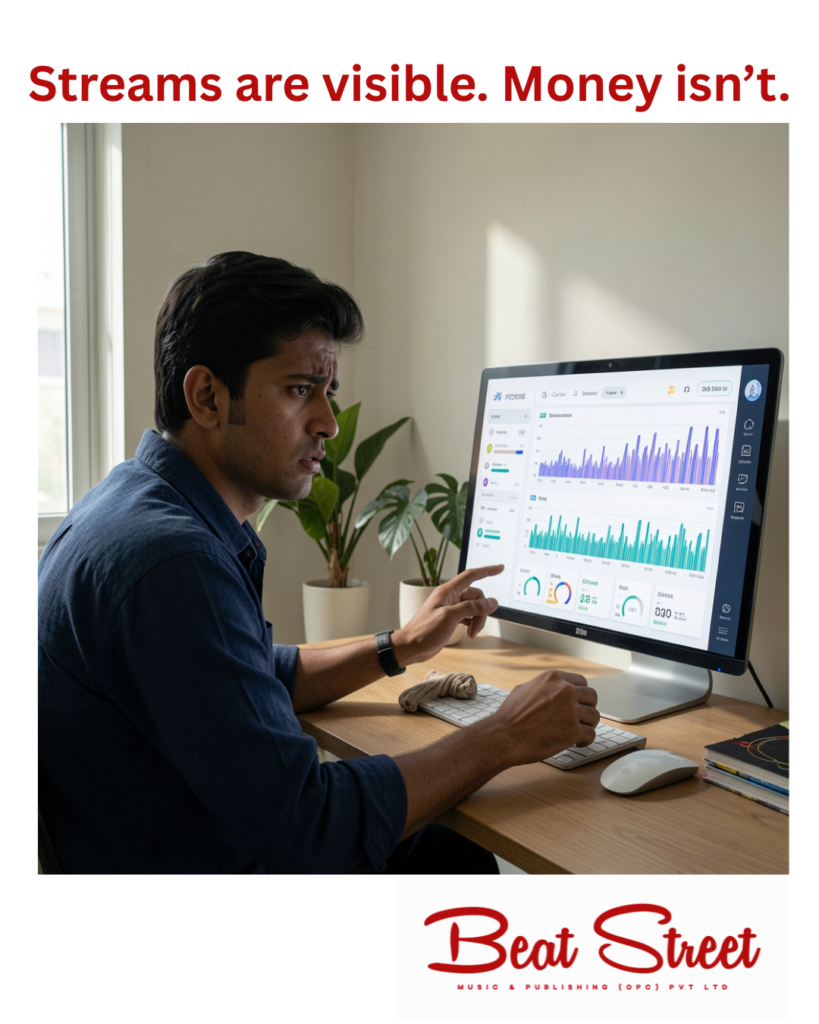
Streams are visible.
Royalties are not.
And the two rarely move together in a predictable way.
It is easy to assume that once music is live and generating activity, value will follow. That streams will translate into revenue, and that revenue will eventually reach the right people.
In many cases, that assumption does not hold.
Not because the system is slow.
But because the system never had enough clarity to assign value in the first place.
The Assumption That Drives Confusion
Streaming platforms have made music consumption transparent. Numbers are visible in real time. Plays, views, engagement, all of it can be tracked.
This visibility creates a natural expectation. If usage is visible, then value must also be accumulating somewhere.
But streaming data and royalty systems operate differently.
One measures activity.
The other depends on recognition.
And recognition is not automatic.
Where The Disconnect Begins
For royalties to flow correctly, multiple layers need to align.
The recording needs to be correctly linked to its underlying composition.
The contributors need to be consistently identified across systems.
Ownership needs to be clearly defined and documented.
Publishing needs to be activated and connected.
If any of these layers are incomplete, the system does not stop and flag an error. It continues processing, but without assigning value accurately.
From the outside, nothing appears broken.
The music is available.
It is being used.
The numbers are growing.
But the connection required for value to flow is weak or missing.
And when that connection is missing, the activity continues, but the value never attaches.
The Invisible Gap
One of the most misunderstood aspects of royalties is the absence of friction.
There are no alerts indicating that something is wrong.
There is no notification that a work was not recognised correctly.
The system does not interpret intent.
It does not attempt to resolve inconsistencies.
It simply processes what it has been given.
Which means that when information is incomplete or inconsistent, the outcome is not delayed.
It is undefined.
Where The Focus Needs To Shift
Most conversations around royalties begin at the point of collection.
By then, the problem has already taken shape.
Royalties are not created at the point of payment.
They are determined much earlier, at the point of structure.
How a work is documented.
How contributors are identified.
How ownership is defined and aligned across systems.
These are not administrative steps. They are the foundation on which value flows.
Streams create visibility.
But visibility does not guarantee recognition.
And without recognition, there is nothing for the system to assign.
Which is why, in many cases, the gap is not between streams and royalties. It is between activity and ownership.
Written by Amit Dubey
Founder, Beat Street Music & Publishing
Leave a Reply