Most rights questions in the music industry are not asked when a song is created.
They are asked later.
Much later.
They surface when a catalogue is being sold.
When a sync opportunity appears.
When an investor starts due diligence.
When a dispute emerges.
When royalties stop matching expectations.
Or when someone finally asks the question nobody thought to ask earlier:
Who owns what?
For years, a song can continue generating revenue despite gaps in documentation, incomplete records, unclear ownership information, or missing agreements.
The music continues to move.
The business around it often assumes everything is in order.
Until money enters the conversation.
The Illusion of Everything Being Fine
One of the most common assumptions in the music business is that if royalties are arriving, the underlying rights must be functioning correctly.
That is not always true.
A catalogue can continue earning for years while carrying unresolved operational issues beneath the surface.
In some cases, a catalogue may continue generating royalties for years despite missing songwriter splits, incomplete agreements, or outdated ownership records. The issue only becomes visible when a licensing opportunity, acquisition discussion, or dispute requires those rights to be verified.
Missing agreements.
Unrecorded ownership changes.
Incomplete split information.
Fragmented documentation.
Unclear chains of title.
These issues often remain invisible because they do not immediately stop revenue from flowing.
The problem emerges when somebody needs certainty.
The Questions That Suddenly Matter
The moment value becomes visible, the questions begin.
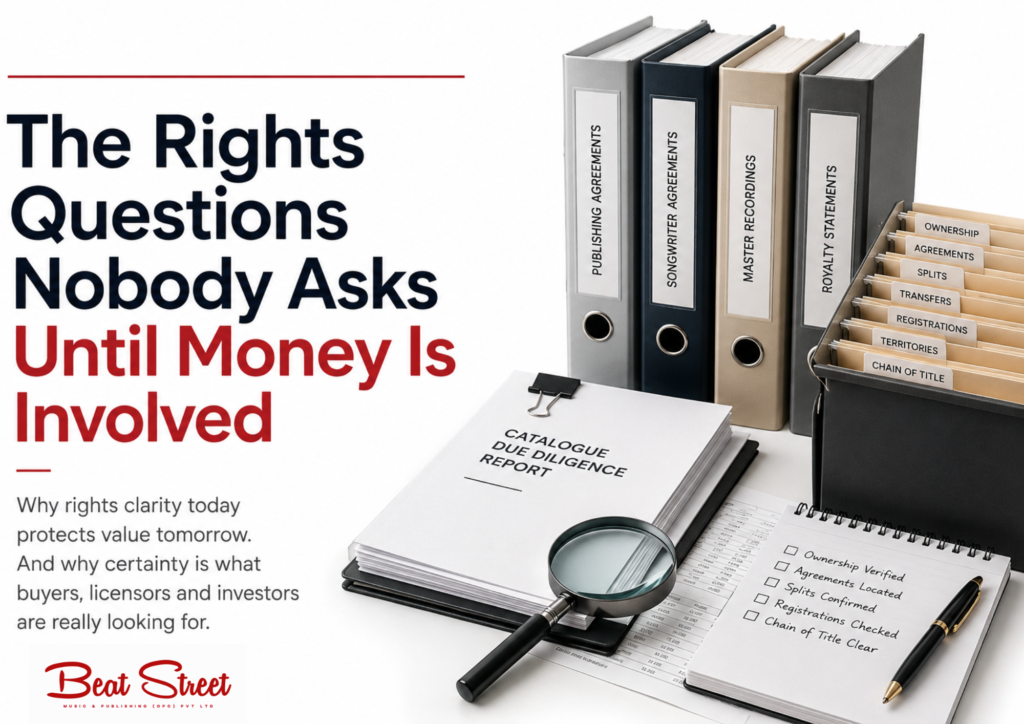
Can ownership be verified?
Are the agreements accessible?
Has every transfer of rights been documented?
Do registrations reflect current ownership?
Can historical decisions be traced?
Is there evidence supporting the shares being claimed?
Questions that once felt administrative suddenly become commercial.
What was once paperwork becomes proof.
And proof often becomes the difference between a smooth transaction and a delayed one.
Why Buyers Think Differently
When a buyer evaluates a music catalogue, they are not only assessing songs.
They are assessing risk.
Revenue is important.
So is confidence.
A catalogue that generates income but lacks supporting documentation creates uncertainty.
And uncertainty has a cost.
It can delay transactions.
Reduce valuations.
Increase legal review.
Or in some cases, cause opportunities to disappear entirely.
Investors are rarely paying only for earnings.
They are paying for confidence in those earnings.
The Hidden Cost of Delay
Many rights issues are relatively easy to address when discovered early.
They become significantly harder when discovered during a transaction.
Locating agreements years later.
Reconstructing ownership histories.
Confirming verbal understandings.
Tracking historical changes.
None of these tasks become easier with time.
In fact, they often become more expensive.
The challenge is that rights management is usually viewed as a maintenance function rather than a value preservation function.
That perception may need to change.
Rights Become Important Long Before They Become Visible
The music industry often focuses on monetisation.
Streaming.
Licensing.
Publishing.
Catalogue acquisitions.
New technologies.
New revenue models.
Yet all of these activities depend on one thing:
Confidence in ownership.
The strongest catalogues are not simply collections of successful songs.
They are collections of rights that can be understood, verified, administered, and trusted.
That work often happens quietly.
Long before a deal appears.
Long before a dispute emerges.
And long before anyone starts asking questions.
Because by the time money is involved, the answers are expected to exist already.
Rights questions rarely become urgent when music is created.
They become urgent when value needs to be proven.
And by then, the answers are expected to exist already.
Written by: Amit Dubey
Founder, Beat Street Music & Publishing
Leave a Reply