Why investors value certainty more than hits
A hit song can dominate charts, generate millions of streams, and remain culturally relevant for decades.
That does not automatically make the catalogue behind it a strong financial asset.
In the music business, revenue attracts attention.
Certainty attracts investment.
Over the last decade, music catalogues have become increasingly attractive to investors, publishers, private equity firms, financial institutions, and specialist acquisition funds.
Royalty income is now viewed alongside other recurring revenue streams.
Predictable earnings.
Long-term monetisation.
Portfolio diversification.
Music has entered the language of finance.
But behind the headlines around catalogue acquisitions lies a reality that is discussed far less often.
Revenue and value are not always the same thing.
Two catalogues generating similar income can command very different valuations.
The difference often lies beneath the songs themselves.
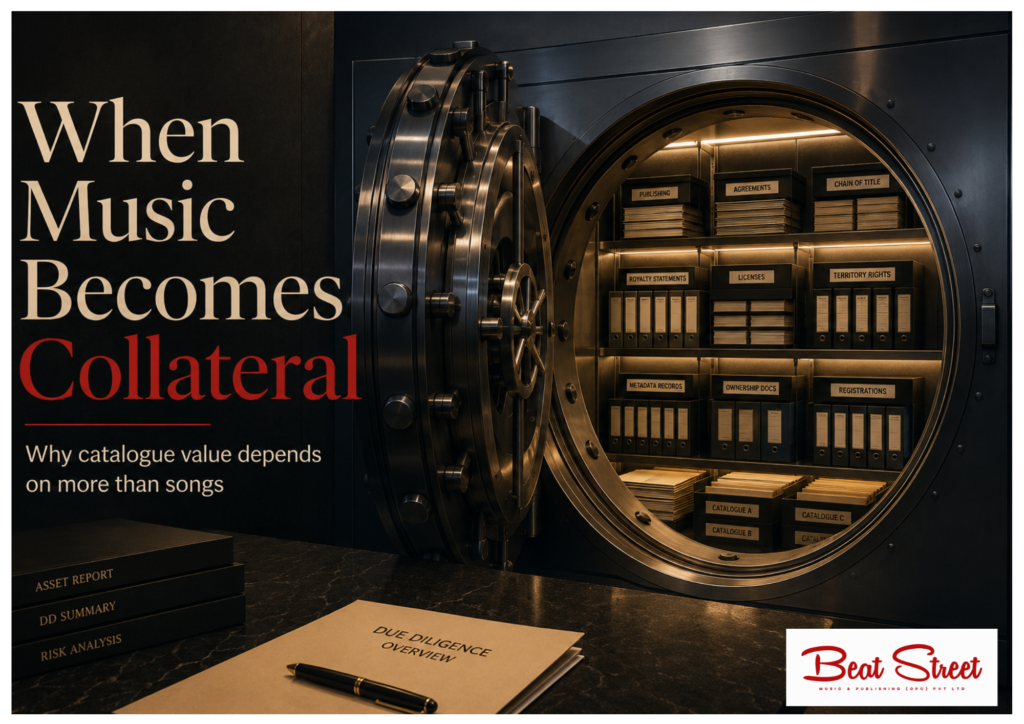
Investors Do Not Buy Songs. They Buy Predictability
Many rights holders assume that catalogue value is primarily determined by musical success.
Streams.
Licensing activity.
Commercial history.
Audience engagement.
These factors matter.
But investors rarely evaluate music through a purely creative lens.
They evaluate risk.
A financially attractive catalogue is not simply one that earns.
It is one that can continue earning with confidence.
That changes the conversation.
Instead of asking:
How popular are the songs?
Investors ask:
Can ownership be verified?
Are agreements complete?
Can revenue be traced?
Do registrations align across territories?
Can future earnings be projected with confidence?
In finance, predictability carries value.
Uncertainty introduces discount.
The Hidden Discount Behind Catalogue Valuation
This is where many catalogue owners encounter an uncomfortable reality.
Strong revenue does not always translate into maximum valuation.
A catalogue may contain commercially successful works and still raise concerns during due diligence.
Consider a catalogue with:
- incomplete songwriter splits
- inconsistent metadata across territories
- missing legacy agreements
- fragmented royalty reporting
- unresolved ownership history
Revenue may continue to flow.
But uncertainty changes how confidently future earnings can be assessed.
And confidence influences value.
An investor does not simply evaluate what a catalogue earned yesterday.
They evaluate how reliably it can continue earning tomorrow.
This is why two catalogues with similar commercial performance can produce very different acquisition outcomes.
One presents clarity.
The other presents questions.
And markets price questions differently.
Due Diligence Is Becoming a Valuation Tool
As music catalogues increasingly enter investment and financing conversations, due diligence is evolving beyond administrative review.
It has become a valuation tool.
Before committing capital, buyers and investors seek confidence in:
- Ownership verification
- Rights documentation
- Chain of title
- Royalty traceability
- Contract integrity
- Administrative continuity
- Rights enforceability
This process is not fundamentally different from evaluating any income-generating asset.
The stronger the operational foundation, the lower the perceived risk.
And lower risk influences valuation.
This is why catalogue transactions increasingly involve not only creative and commercial analysis, but operational analysis.
The music matters.
But so do the systems supporting the music.
When Music Becomes Finance
Perhaps the clearest sign of this shift is the growing treatment of music rights as financial infrastructure.
Future royalty income can support lending discussions, acquisition strategies, structured investments, and long-term asset planning.
However, this only works when the underlying rights ecosystem can support financial confidence.
Lenders and investors do not simply review royalty statements.
They examine the systems behind those statements.
Can ownership be proven?
Can rights be enforced?
Can income be tracked?
Can liabilities be identified?
Can earnings continue without operational disruption?
These questions increasingly shape financial conversations around music.
In many cases, infrastructure quality becomes inseparable from asset quality.
The Next Chapter of Catalogue Ownership
The music industry is entering a period where ownership, administration, and finance are becoming deeply interconnected.
For catalogue owners, this creates both opportunity and responsibility.
The opportunity is clear.
Music rights can become long-term financial assets with enduring commercial value.
But financial value does not emerge from songs alone.
It emerges from confidence.
Songs create cultural relevance.
Rights clarity creates commercial durability.
In the years ahead, the strongest catalogues may not simply be the most successful creatively.
They may be the ones investors trust most operationally.
Because in the modern music economy, investors do not only buy music.
They buy predictability.
—
Written by: Amit Dubey
Founder, Beat Street Music & Publishing
Leave a Reply