For most of music history, distribution was the wall that kept most artists out.
Recording a song was only the first step. Getting it into stores, onto radio, or into the hands of listeners required infrastructure, capital, and industry access. Labels controlled that system because they controlled the pipes.
Streaming changed that.
Today, a song can reach a global audience within minutes of being uploaded. An artist in Mumbai, Lagos or São Paulo can release music and be available everywhere at the same time. Distribution, once the most powerful gatekeeper in music, has largely been solved.
But even as the industry settles into streaming, another shift is already testing the foundation beneath it.
Artificial intelligence is starting to change not just how music is distributed, but how easily it can be created.
And that could test the limits of the streaming model in ways the industry is only beginning to understand.
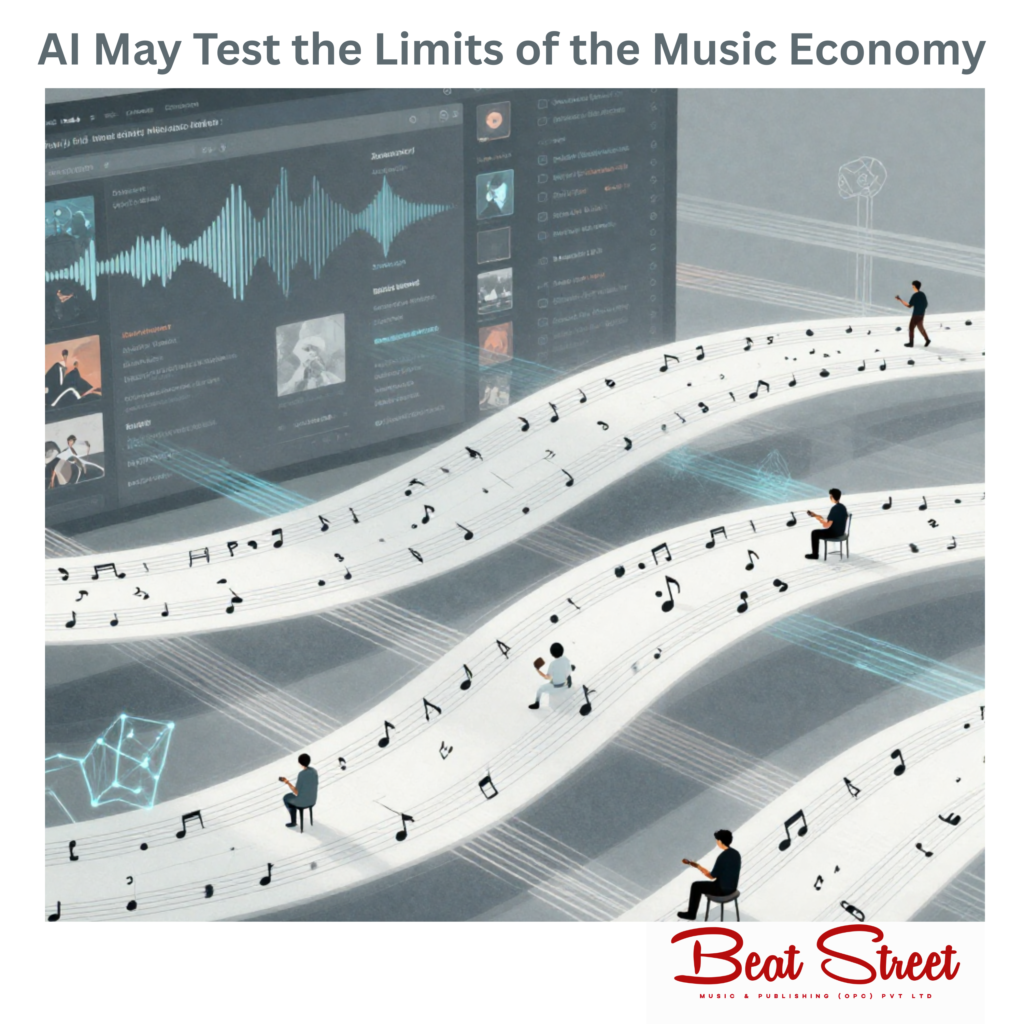
From Scarce Distribution to Expanding Supply
Streaming platforms were built around the idea of abundant music. Unlike physical formats, there was no shelf space to run out. Digital platforms could host millions of songs without worrying about storage in record stores or manufacturing costs.
This abundance allowed more artists to release music than ever before. Independent creators, small labels and bedroom producers could all participate in the global music economy.
But the basic assumption behind this system was still that music required human time and effort to create.
AI changes that assumption.
With generative music tools improving rapidly, it is becoming possible to produce large volumes of music in very little time. A single creator can generate dozens or even hundreds of tracks using AI assisted workflows.
What was once an industry limited by the pace of human creativity could become one defined by automated scale.
This raises a question that the streaming model has not yet fully confronted.
What happens when the supply of music expands faster than the systems designed to track and value it?
The Pressure on the Streaming Economy
Streaming services distribute revenue based on listening activity. The total subscription and advertising revenue forms a pool that is then divided across the music that people stream.
When the catalogue grows gradually, the system adapts.
But if the number of tracks entering platforms begins to increase dramatically, the economics become more complex.
More music competing for attention means each individual track is fighting for a smaller share of listening time. It also means the royalty pool must stretch across an ever expanding catalogue.
The challenge is not just volume.
It is attribution.
If AI generated music begins to appear at scale, the industry will have to answer some difficult questions.
Who owns the music that AI systems generate?
Who should be credited when training data includes existing songs?
How should royalties be distributed when the line between human and machine creation becomes blurred?
These questions are already beginning to surface across the global music industry.
Platforms Are Beginning to Respond
Streaming services and industry bodies are starting to recognise that AI will require new frameworks.
Some platforms are experimenting with ways to identify or detect AI generated music, while others are exploring policies around training data and transparency.
The objective is not to stop technological progress. AI will undoubtedly become part of the creative process in many areas of music production.
The real issue is governance.
The industry needs systems that can distinguish between human created works, AI assisted creations and fully automated outputs. Without clarity, attribution and royalty distribution could become increasingly difficult to manage.
And if listeners cannot easily distinguish what they are hearing, trust in the system may also be affected.
The Implications for Emerging Markets Like India
For markets such as India, this shift carries both opportunity and risk.
India is already one of the fastest growing streaming markets in the world. Millions of listeners are entering the digital music ecosystem every year. Artists from independent scenes, regional languages and new genres are finding audiences that were previously impossible to reach.
At the same time, the infrastructure around rights, metadata, and catalogue documentation is still evolving. In markets where streaming is growing faster than the documentation systems behind it, AI could widen the gap between music that is heard and music that is properly tracked.
As AI generated music becomes more common, the importance of accurate metadata, ownership records and rights management will only increase. Without strong documentation systems, distinguishing between legitimate works and automated outputs could become much harder.
This is where the next phase of the music industry will likely be decided.
Not only by creativity, but by the systems that support it.
A Reality Check the Industry Cannot Ignore
Signs of this shift are already beginning to appear across the global music industry.
AI generated tracks are increasingly appearing on streaming platforms. Some distributors and platforms have started introducing policies around disclosure and identification of AI created music.
Rights holders are also raising questions about how generative models are trained and whether existing catalogues are being used without proper licensing.
These conversations are not limited to the United States or Europe. They will eventually affect every streaming market.
For countries like India, where streaming growth is accelerating and millions of new listeners are entering the ecosystem each year, the pressure on rights documentation and metadata infrastructure could become even more visible.
The question is no longer whether AI will enter the music ecosystem.
The real question is whether the industry’s rights infrastructure can keep up with it.
What the Industry Must Solve Next
For decades, the music business focused on controlling access to distribution.
Streaming changed that. Music can now travel anywhere instantly.
The next challenge is different. It is about maintaining trust in the system that assigns value to music.
The industry will need stronger ways to answer three simple but increasingly difficult questions.
Who created the work.
What data it was trained on.
Who should be paid when it is consumed.
Without clear answers, the economics of streaming could become harder to sustain and harder for creators to trust.
Technology will continue to expand what is possible in music. That has always been true.
But every technological shift eventually forces the industry to strengthen the invisible systems behind it.
Rights documentation.
Metadata accuracy.
Attribution.
These quiet systems rarely get attention. Yet they are what ultimately determine whether creators are paid fairly and whether the music economy remains sustainable.
These systems are not glamorous.
But in the next phase of the music industry, they will determine who gets paid and whose work disappears into the noise.
If you are a label, publisher, or creator thinking about how AI, metadata, and rights management will shape the next phase of the music business, this is the moment to start building the right strategy. If you would like to explore how to strengthen your catalogue, rights framework, or royalty systems for this new landscape, let’s connect.
Written by Amit Dubey
Founder, Beat Street Music & Publishing
Leave a Reply