Every few months, a familiar complaint resurfaces.
Songs are getting shorter. Hooks arrive faster. Bridges are disappearing. Albums feel less central than they once were.
The conclusion many people jump to is simple. Music has become worse.
But that explanation misses something important.
What changed is not creativity. What changed is the economic system that surrounds it.
And when the economics of distribution change, creative behaviour usually follows.
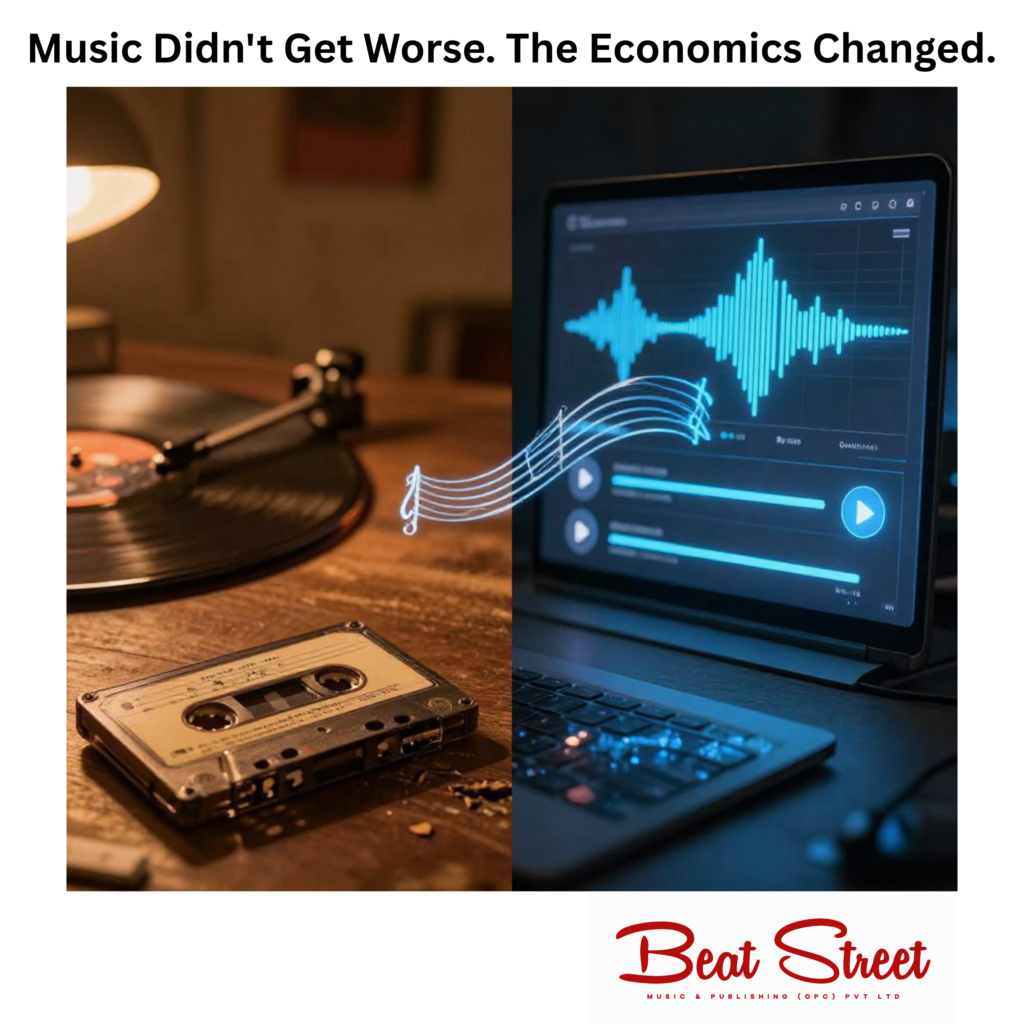
When Albums Paid the Bills
In the physical era, the economics of music were built around albums.
A listener bought a cassette or a CD. An artist earned a share from that sale. Labels invested heavily in recording because each successful album could generate meaningful revenue.
The incentive was clear. Make a body of work that people wanted to own.
Songs could take their time. Introductions were longer. Albums were designed to be experienced from start to finish.
The success of music depended on how many people chose to buy it.
Streaming changed that equation completely.
The Streaming Economy
Today most listeners access music through platforms such as Spotify, Apple Music and YouTube Music.
Instead of purchasing music once, listeners stream it repeatedly. Revenue is distributed across millions or billions of plays.
The result is a very different economic model.
A single purchase once generated a meaningful payment. Today songs earn fractions of a dollar per play, which means meaningful income depends on massive scale.
For artists and composers, this creates a new reality. Visibility and repeat listening matter more than ever before.
And that is where creative decisions start to shift.
Why Songs Feel Different Today
Streaming platforms measure listener behaviour closely.
They track when listeners skip. They observe whether a song is replayed. They measure completion rates.
These signals help algorithms decide which songs should be recommended to more listeners.
As a result, creators have gradually adapted their writing and production choices.
Hooks appear earlier in the song. Intros are shorter. The structure becomes more immediate.
In many cases, listeners now discover a song through a short clip on social media before hearing the full track on a streaming platform. Capturing attention quickly becomes part of the creative strategy.
This is not because artists suddenly forgot how to write complex music. It is because the environment rewards immediacy.
In a world where a listener can skip within seconds, the first moments of a song matter more than ever before.
The Indian Reality
The shift is particularly interesting in India.
For decades, the music industry here was driven by film soundtracks and physical sales. Music labels built vast catalogues through cinema. Revenue was closely tied to the success of films.
Streaming platforms changed that relationship.
Today, many songs are discovered through playlists, short form video platforms, and algorithmic recommendations rather than film releases alone.
Independent artists are reaching audiences directly. Regional music is travelling beyond linguistic boundaries. Old catalogues are finding new life through streaming discovery.
At the same time, the economics remain challenging for many creators.
High streaming numbers do not automatically translate into sustainable income unless rights, publishing, and catalogue ownership are structured carefully.
In a system where revenue accumulates across millions of plays, the accuracy of ownership data becomes critical.
This is why conversations around music rights, metadata, and catalogue clarity are becoming more important in India.
The structure of the industry is evolving along with the technology.
Scale Versus Meaning
One consequence of streaming is scale.
Technology now makes it possible to release more music than ever before. Thousands of tracks appear on platforms every day.
But volume is not the same as meaning.
Listeners still connect with songs because of emotion, identity, memory, and storytelling. Music is rarely consumed as pure sound alone. It carries cultural context.
Algorithms may recommend songs, but audiences ultimately decide which ones become part of their lives.
That human connection remains the foundation of music.
What This Means for Creators
For creators, the lesson is not to resist change. Every technological shift in music has reshaped how artists work.
Radio changed distribution. Television changed promotion. Digital downloads changed access. Streaming changed consumption.
The important question is how creators adapt strategically.
Understanding rights ownership, maintaining clean metadata, and managing catalogues thoughtfully are becoming essential skills.
In a system driven by scale and discovery, well documented catalogues and clear ownership structures can make a significant difference to long term value.
The Real Conversation
The conversation about music quality often misses the deeper point.
Songs did not suddenly become simpler because artists lost ambition.
They evolved because the environment changed.
Distribution shapes incentives. Incentives shape behaviour. Behaviour eventually shapes culture.
Streaming did not make music worse.
It simply rewrote the rules of how music survives.
I work with composers, publishers and rights holders on catalogue clarity, metadata readiness and navigating the structural shifts reshaping music. If you are preparing for an AI aware and streaming driven future, these conversations are worth having early.
Written by Amit Dubey
Managing Director, Beat Street Music & Publishing
Leave a Reply