If AI is trained on human music, shouldn’t credit and compensation travel back to the humans, not just the algorithms?
Copyright law has traditionally protected work that arises from human effort, intention, and creative judgment. In simple terms, it safeguards expression that can be traced back to a conscious human act.
This is where AI complicates things.
When a piece of music sounds indistinguishable from something a person might have composed, but the process behind it is largely automated, where do we draw the line for authorship? At what point does human involvement meaningfully shape the outcome, and when does it become closer to operating a tool?
If a creator tweaks a prompt, refines a few words, or nudges a model in a particular direction, does that intervention qualify as creative authorship? Or is it simply configuring a system rather than creating a work?
These questions may feel theoretical today, but they sit at the heart of how copyright will need to evolve. The law cannot rely only on how human the final output appears. It has to examine where creative judgment actually resides.
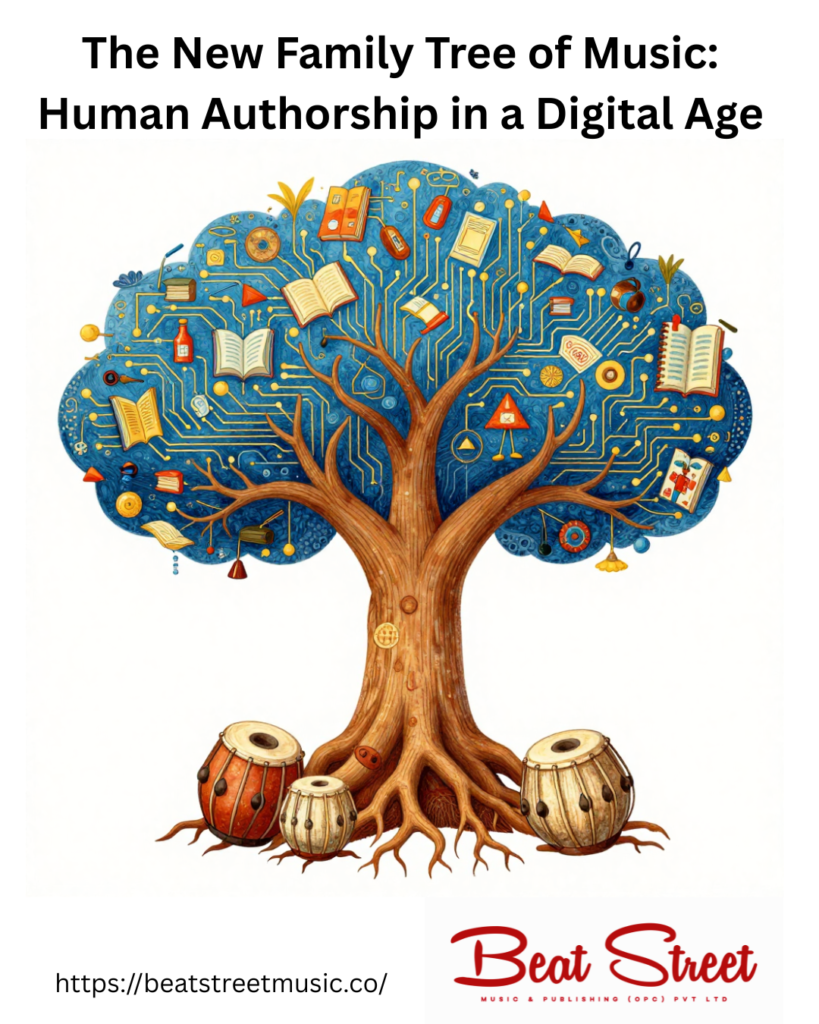
A Lesson From Recreated Works
The music industry already offers a useful reference point.
Take Ek Ho Gaye Hum Aur Tum from the film Bombay. The song was composed by A. R. Rahman, written by Mehboob, and sung by Remo Fernandes. Years later, when The Humma Song was recreated for OK Jaanu, the system did not erase the original work.
Rahman’s authorship remained intact. Mehboob continued to be credited as the lyricist. The recreated version openly acknowledged its lineage, even while adding new performers, new production layers, and a contemporary sound.
What changed was the expression.
What did not change was the origin.
That distinction matters.
The recreated version extended the life of the work without disconnecting it from its source. Credit flowed backward as well as forward. Royalties followed attribution. This was not just ethical. It was good system design.
Now imagine applying that same logic to AI generated music.
If an AI generated track were required to transparently declare its source material and lineage, a composer sitting in a small town like Chaibasa in Jharkhand could still be credited and paid if fragments of their work informed a track released by an artist in Spain or anywhere else in the world.
That is the real opportunity here. Not erasure, but inclusion. Not fear, but design.
Where AI Forces a New Question
Copyright law protects works that arise from human labour, effort, and creative judgment. AI challenges this not because the output looks human, but because the process often is not.
Changing a sentence in a prompt or adjusting parameters may influence the result, but influence alone is not the same as authorship. The difficult task ahead is defining where human creativity meaningfully shapes the outcome, and where it stops.
This distinction matters because without it, we risk either denying protection to genuine human creativity or granting ownership where little creative judgment actually exists.
Global Signals Are Already Emerging
Around the world, the industry is responding in fragmented but revealing ways.
Bandcamp has taken a strict position by banning AI generated music entirely from its platform. Deezer has begun tagging AI generated tracks and is experimenting with systems to prevent AI driven streaming fraud from distorting royalties. Governments like the United Kingdom have publicly acknowledged the need to revisit copyright frameworks after strong pushback from creators.
These are not theoretical discussions. Platforms and policymakers are already shaping how AI music will be treated in practice, even as the law struggles to keep pace.
The Indian Context
In India, this conversation is still taking shape, but it has clearly begun.
Government bodies and policy groups have started releasing discussion papers and consultation notes examining how artificial intelligence intersects with copyright, licensing, and creator remuneration. These early signals reflect an acknowledgement that existing frameworks may not fully address the realities of AI assisted creation.
As of January 2026, no country has enacted a comprehensive AI specific copyright law. However, several jurisdictions, including India, are actively debating possible approaches. The focus so far has been on understanding authorship, accountability, and how value should flow when human creativity and machine systems operate together.
This moment presents an opportunity. India can learn from global debates while designing frameworks that protect creators without resisting technological progress.
A Question Worth Sitting With
The question is no longer whether machines can create convincing music. They already can.
The real question is whether our copyright systems are prepared to recognise, measure, and protect human creativity when it operates alongside machines rather than in isolation.
If we get this right, AI does not have to weaken creative economies. It could strengthen them, especially for creators who have historically remained invisible or underpaid.
But that only happens if we design for clarity, not convenience.
And that work, like most foundational work in music, happens quietly.
As technology evolves, how will you define your own authorship in the music you create?


Leave a Reply