A composer in India may never see a rupee from FM radio. Songs play. Stations earn. But the creator is invisible in the royalty chain.
That’s the reality we all know.
But here’s the twist.
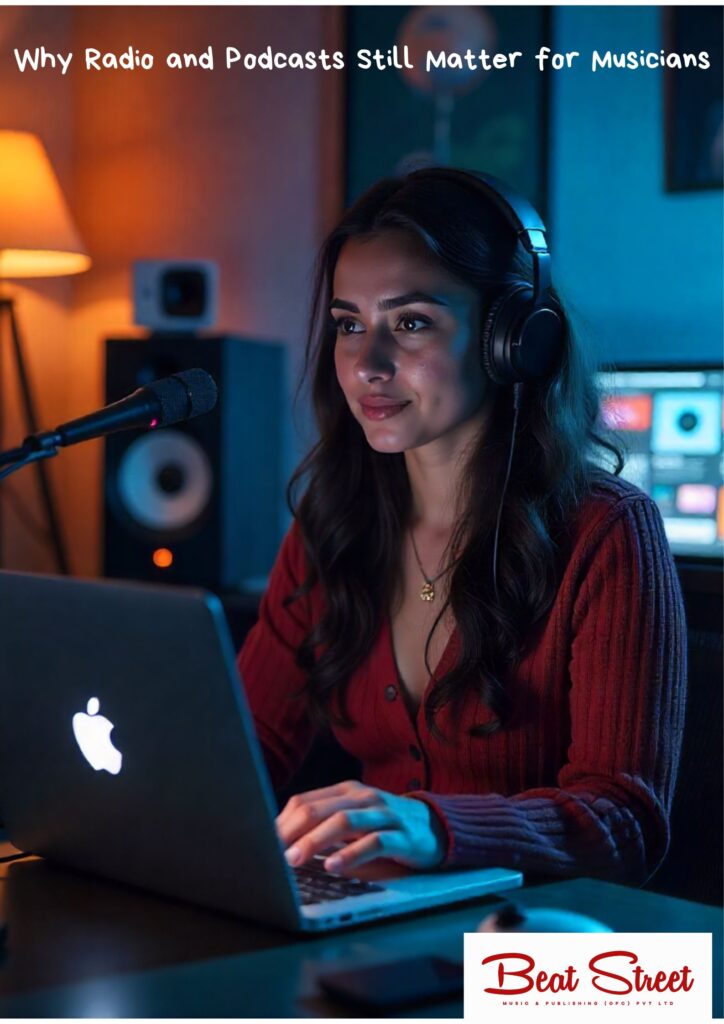
Digital radio and podcasts are changing that story.
When your track plays on a station inside Apple Music or TuneIn, it’s not just exposure. It’s data. And data means royalties. The system can actually trace the song back to you; if your rights are in order.
Podcasts too are turning into discovery platforms. A sync on a Spotify podcast or a feature in an indie show can trigger streams, Shazams, and even licensing requests. One placement can unlock a chain of revenue opportunities.
The global industry has already seen this shift. In the US and Europe, spins on digital radio feed into performance rights systems. Podcasts spark sync deals and catalogue re-discoveries.
India is behind, but the opportunity is real. FM may rarely pay you directly, but digital platforms are built to. Creators who prepare now will be the first to benefit.
So what should you do?
Make sure your works are properly registered with your publisher or society.
Distribute not just to Spotify and YouTube, but also to digital radio services.
Track podcast mentions of your songs — and follow up for rights clearance if needed.
The message is simple. Radio and podcasts are no longer “just exposure.” They are entry points into the royalty system. And if your catalogue is ready, they can still change your story.
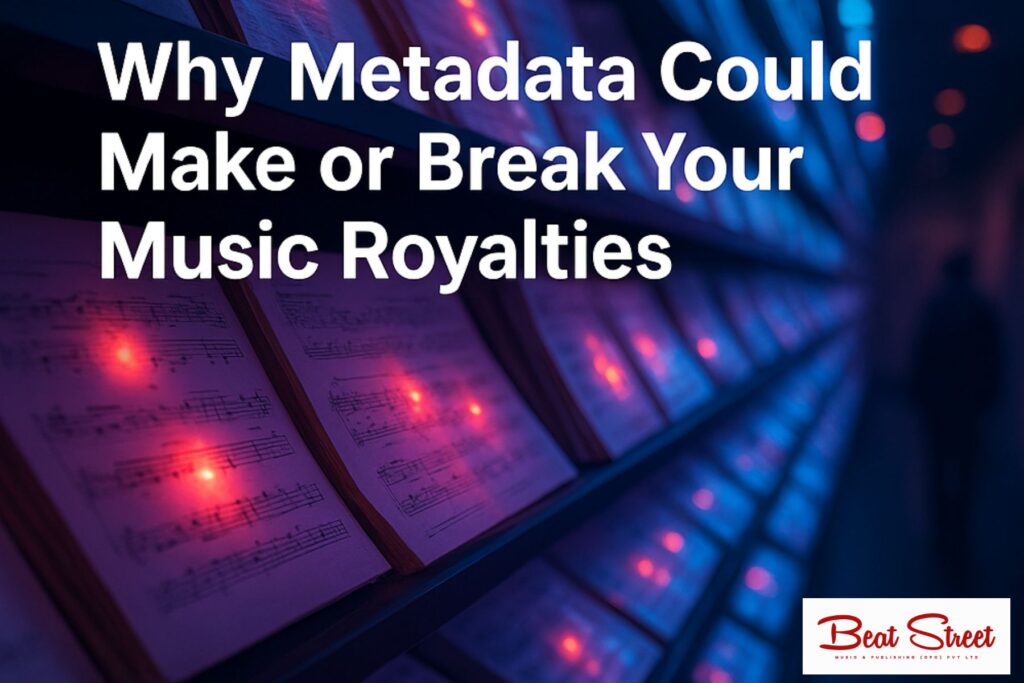
Every song has two lives. One is the sound you hear. The other is the data behind it.
That hidden layer is called metadata. It tells the world who wrote the song, who performed it, who owns it, and who gets paid.
When metadata is clean, royalties flow. When it is wrong or missing, royalties vanish.
Why Metadata Matters
For a composer or lyricist, metadata is proof. It links your name to your work in global systems. Without it, your song can travel the world and you may never see a rupee.
For labels and publishers, metadata is the backbone of licensing. It powers deals with streaming platforms, film producers, OTT players, and advertisers. Bad data means missed money and broken trust.
The Common Mistakes
Here’s what I see most often:
Song titles uploaded with typos or inconsistent spellings.
Composer and lyricist names entered in short forms like “Ankit” or “Chetan” instead of full names.
Ownership splits left blank or misreported.
ISRC and ISWC codes not registered or not linked to the right rights holders.
Each of these errors creates cracks in the system. And in those cracks, royalties get lost.
The Opportunity
India is still young in terms of digital rights. That is both a problem and an opportunity. If we fix metadata now, we build a system that actually rewards creators.
Globally, clean metadata has unlocked billions in sync, publishing, and performance royalties. There is no reason Indian composers, authors, and labels should be left behind.
The Future
AI is already scanning catalogs, matching works, and flagging disputes. Streaming platforms depend entirely on metadata. The upcoming Central Music Registry in India will live or die based on data quality.
The message is clear. Metadata is not admin work. It is the foundation of your royalties, your career, your rights.
Creators, labels, publishers: if you do one thing this year, let it be this:
Get your metadata right.Start by auditing your last five releases, and ensure every field is complete and accurate on your distributor’s portal.
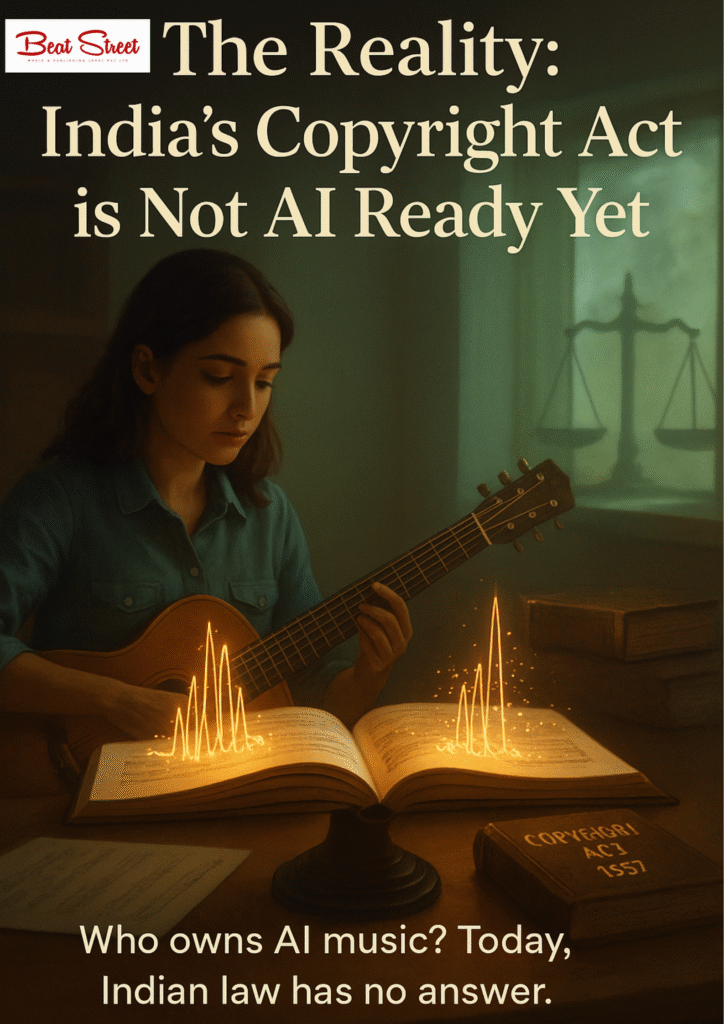
Imagine you are a songwriter. Tomorrow you find an AI track on a platform that sounds almost like your last release. Who owns it? Who gets paid? Today, Indian copyright law has no answer.
India’s Copyright Act, 1957 was written for another time. Even with the big 2012 update that added digital protections, the law says nothing about artificial intelligence. This silence creates three big problems for the music world.
1. Authorship and Ownership
The law says the author is a person. Courts interpret this as a human or a company. Purely AI-generated works, with no human input, fall into the public domain. That means no copyright. Anyone can copy or use them. For creators and companies, this destroys value.
2. Training Data and Infringement
AI systems learn by scraping content. Your songs or lyrics may already be part of that data. But the law does not clarify if this is fair use or infringement. Rightsholders argue it is theft. AI companies say it is transformative. Until a court decides, it is a grey zone.
3. Liability and Transparency
What happens if an AI track copies your melody? Who is responsible? The developer? The user? The platform? No one knows. There is also no rule that forces AI companies to disclose their training data. Without transparency, creators are left in the dark.
Why There is Confusion
The government is sending mixed signals:
Recent draft copyright rules only spoke about digital payments. They did not touch AI.
A committee was formed in April 2025 to study the issue. Their report is not public yet.
Ministers have said AI developers need permission to use copyrighted works. But this is policy talk, not law.
The big test case is ANI versus OpenAI, now in the Delhi High Court. The verdict could push the government to act. Until then, the law is unclear.
How India Compares Globally
In the United States, copyright requires human authorship. Pure AI works cannot be protected. Clear but strict.
In the European Union, the AI Act demands transparency and gives rightsholders the power to opt out. Strong focus on creator rights.
In the United Kingdom, the law protects computer-generated works. It credits the person who arranged the creation. A progressive model.
India sits in the middle. Ambiguous and waiting for reform.
What Might Happen Next
The committee will likely look at global models. Possible outcomes include:
Adding a clear exception for text and data mining in research.
Creating collective licensing or opt-out frameworks for training data.
Distinguishing between AI-assisted works, which remain copyrightable, and AI-only works, which may not.
What This Means for You
Composers and lyricists should document their process. Show your human input when using AI tools. Labels and publishers should start drafting contracts that address AI-created works. Artists should not rely only on AI tracks for long-term value. They may not be protectable. Tech companies should prepare for licensing systems. Change is coming.
Closing Thoughts
India’s talent is unmatched. The creator economy is growing fast. But unless the law keeps up with AI, the people who write, compose, and perform will lose value.
Right now the law is behind. The government is watching and waiting. For creators, this means living with uncertainty. For companies, it means planning ahead. For all of us, it means pushing for a balance between innovation and rights.
The next few months will decide if India leads or lags in protecting creativity in the age of AI.
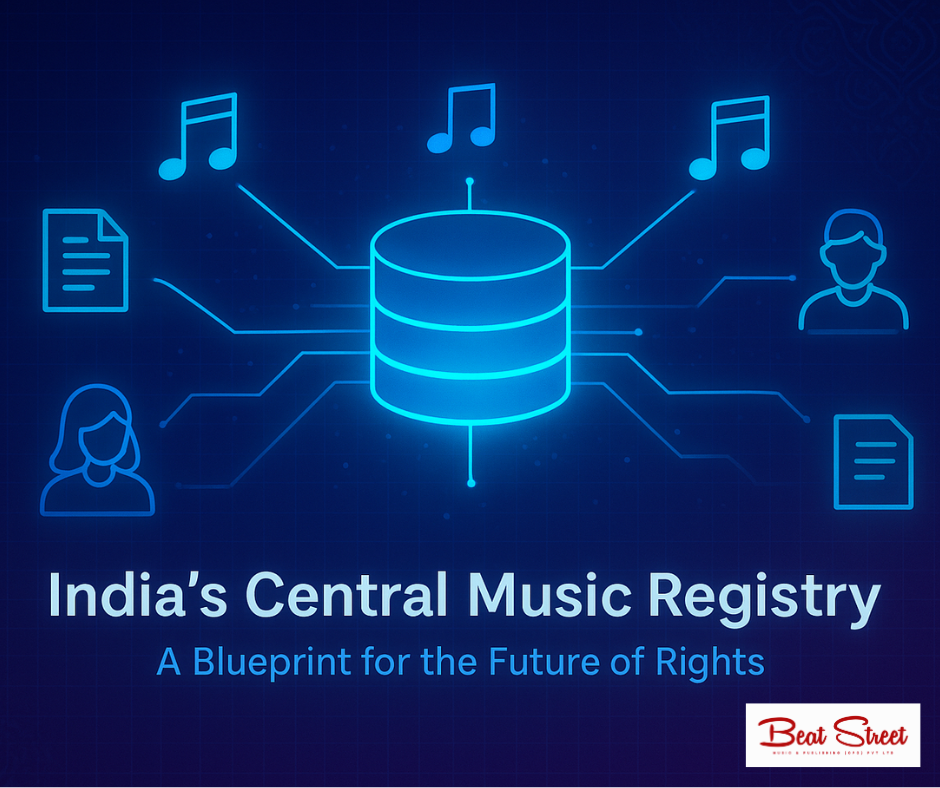
India is tackling music’s oldest problem: chaos. By October 2025, a Centralised Digital Music Licensing Registry will launch. This is not just bureaucratic news. I see it as a potential blueprint for the global creator economy.
Right now, music licensing in India is a fragmented mess. Multiple societies. Manual processes. Endless disputes. Royalties vanish in the chaos. This registry promises to be a single source of truth.
For creators and publishers, this is the first step toward real transparency. The value is direct. Faster licensing for anyone who needs music. Fewer disputes over ownership. Cleaner metadata ensures royalties reach the right people. Faster. This is how you build trust. This is how you ensure creators get paid. Period.
The impact will ripple far beyond recordings. The registry was announced at a meeting focused on promoting live events. That connection is critical. Imagine a filmmaker or game developer clearing a song in minutes, not months. This speed could unlock massive value in India’s booming OTT and gaming markets.
This is how I see it: the world should be watching. While the US navigates complex blanket licenses and Europe operates in silos, India is building a digital-first, centralised system. This is not just an Indian solution. It is a template for every emerging music economy.
But let us be clear. This registry is not a magic bullet. It is critical infrastructure. Its success hinges on one unglamorous factor: data hygiene. Garbage in, garbage out. The system’s power will only be as good as the metadata we feed it.
In my experience, the timing is perfect. As AI-generated music floods the market and global rights debates intensify, we need systems built for transparency and speed. India is not just fixing a local problem. It is building a foundation for the next era of music.
So what does this really mean for creators and labels? The responsibility for accurate metadata now shifts to us. We must get our own data in order. Now.
The registry is a start. It signals a crucial shift. A move toward a system where technology finally serves creativity, not the other way around.
India’s music revenue has slipped. Legacy labels like Saregama and Tips have seen their stock drop. Some say it is a small correction. I believe it signals something deeper.
The industry has placed too much faith in streaming. That bet is no longer safe.
This is not just India’s story. It is a warning for the world.
Streaming Has Stalled
Streaming rescued music from piracy. It created recurring revenue and global access. But the model is slowing.
In India, Wynk and Resso have already shut shop. Globally, subscription fatigue is rising. Payouts remain too low for the value music generates.
Streaming is not the future anymore. It is the present, and it is flattening.
What Comes Next
The path forward lies beyond streaming. Four priorities can unlock growth:
1. Regional and niche catalogues India has music in more than 22 languages. Globally, local sounds are travelling faster than ever. Diversity is the next frontier.
2. Sync and licensing Film, OTT, games, and advertising still underpay music relative to its value and audience engagement. Sync is already a lifeline in many markets. It should be central, not secondary.
3. Creator-direct income Fan subscriptions, live shows, memberships, and direct deals are here to stay. Building your own audience is the safest hedge against market shifts.
4. Policy and rights reform Royalties in India are still blocked by weak systems and bad metadata. The same problem exists worldwide still bottlenecked by weak systems. Without clean data and transparent rights management, creators will always lose.
The Crossroads
The lesson is clear. Streaming alone will not sustain us. Growth will come when the industry fixes rights, expands licensing, and empowers creators to go direct.
This moment is make-or-break. For India. For the world.
And for every artist, composer, and label; the real question is simple:
Are you chasing streams, or building something that lasts beyond them?
What if you could generate a hit song with AI, only to find out you don’t actually own it. It can get worse, you can’t stop someone else from stealing it? That’s the unsettling reality at the heart of a new legal battle between AI music generator Suno and a group of independent artists.
Suno’s core defence is bold: their AI doesn’t “sample” music, it generates entirely new sounds. Therefore, they argue, it can’t infringe copyright. It’s a technicality that could reshape the entire industry.
The Legal Defence: Section 114(b) (U.S.)and “No Sampling”
At the heart of Suno’s case is a specific part of US copyright law that protects the actual sound of a recording. Suno argues that since it doesn’t copy-paste audio snippets (samples), they are following the law. So even if an AI song sounds identical to an existing track, it isn’t a “sample” in the legal sense.
It’s a bold stance. If courts accept it, AI music could be shielded from many infringement claims.
Think of it like this: It’s the difference between someone stealing a master recording from your hard drive (illegal) and a soundalike singer perfectly imitating your voice on a new track (a legal gray area). Suno claims it’s only doing the latter.
The Other Battle: Copyrightability of AI Works
But here’s the twist. While Suno is defending itself in court, its own help pages tell users something important:
If you’re on the free plan, Suno owns the songs (you can use them only non-commercially).
If you’re on Pro or Premier, you own the songs and can monetise them.
But and this is key: 100% AI-generated songs may not qualify for copyright protection in many jurisdictions, including the US, because they aren’t created by a human.
So Suno’s legal defence is about avoiding infringement, but its terms warn users that they might not be able to protect their own songs under copyright law.
Why This Matters for Creators
This creates a bizarre “ownership paradox.” You might have a license to sell the song, but you can’t call the police if someone else takes it. This isn’t an abstract legal debate. It’s about whether a creator using AI can build a sustainable career, or if their work will forever be vulnerable to theft with no recourse.
This dual reality puts creators in a tricky position:
You may be able to distribute and monetise your Suno tracks.
But if someone copies or mimics them, you may struggle to claim legal protection — unless you’ve added your own human authorship, like writing lyrics or melodies yourself.
For independent artists, this is the tension. AI tools open new creative doors, but they also raise questions about ownership, protection, and long-term value of IP.
The Bigger Picture
Suno’s motion comes as AI companies face lawsuits worldwide — from US majors like Universal and Warner to Germany’s GEMA. At the same time, federal courts have recently sided with AI platforms in book-related cases, strengthening the “fair use” argument for training AI models.
The outcome of these cases will decide not just whether AI platforms survive, but also how creators and rights-holders get compensated (if at all).
My Take
Suno’s argument is clever: “we don’t sample, so we don’t infringe.” But for artists, the bigger issue is different: even if you create something on Suno, can you truly own it?
Until copyright law catches up, creators using AI music tools should think carefully:
Add human authorship (lyrics, composition input) wherever possible.
Check licensing terms before distributing AI music.
Remember that monetisation ≠ copyright protection.
The AI music revolution isn’t just about technology. It’s about redefining who gets to own, protect, and profit from creativity.
So I want to hear from you: Where should the line be drawn? Does a human just need to type the prompt to claim copyright, or should they have to write melodies and lyrics themselves? Share your take in the comments.
A new UK report on music tech funding reveals critical gaps in support for innovation. For India’s booming music market, these lessons aren’t just interesting; they’re an urgent wake-up call to build the infrastructure our creators deserve.
When Music Technology UK (MTUK) released its Sound Investments’ report earlier this month, one theme stood out: innovation in music tech is moving fast, but funding and policy support are still playing catch-up.
I found myself reading it less as a UK story and more as a mirror for India.
The UK’s Funding Landscape
The report doesn’t just celebrate startups experimenting with AI composition or next-gen royalty systems. It also highlights the gaps: fragmented support networks, too little growth capital, and the difficulty of turning a smart prototype into a scalable business.
Even with government recognition of creative industries, music tech often feels like the “niche within the niche.” Seed funding is available, but scaling beyond that remains the real hurdle.
India’s Parallel Reality
I’ve seen promising startups stall.India’s context is different but surprisingly parallel. Just last week, I spoke with a founder building a brilliant solution for Indian regional music but can’t get past the investors because they don’t understand the market. They want them to shoot regional songs in UK!
Streaming consumption is surging, short video and OTT platforms are reshaping listening, and we have no shortage of tech talent.
Yet ask yourself: where are the dedicated music tech funds?
I’ve seen promising startups in rights management, metadata standardisation, transparent royalty accounting, and sync tools stall; not because the ideas lack merit, but because the funding pipeline doesn’t exist. Unlike the UK, where at least there’s structured dialogue, India hasn’t even begun to place music tech on its policy or investment map.
Why This Matters: It’s About the Invisible Plumbing
This isn’t only about new platforms or apps. It’s about finally fixing the broken, invisible plumbing of our industry. The things creators rarely see but always feel: missing royalties, opaque deals, underreported plays, delayed payments.
Without investment in this infrastructure, Indian IP risks staying dependent on global platforms instead of building long-term value at home.
The Takeaway: A Call for Recognition
What I admire about the UK report is its honesty. They acknowledge that capital doesn’t always flow to where innovation is. For India, that’s a wake-up call.
We don’t need to wait for a government white paper. The time for action is now. We need investors, policymakers, and the music industry to start recognising music tech not as an add-on, but as the infrastructure that will decide whether our creators thrive or simply survive.
Because the real question isn’t whether Indian artists will keep growing globally… they already are. The question is whether our technology and capital will grow with them, or whether that value will once again slip away to others.
Last week, screenshots of TikTok’s website appearing live in India created a sudden buzz. Many thought, “Is it back?!” and hope ran high.
But within hours, both government sources and TikTok confirmed that the ban imposed in June 2020 is still in place. What people saw was most likely a technical glitch, not a policy change.
Still, that moment revealed something much bigger: Indian creators are starved for real platform opportunities that go beyond quick dance trends.
The Promise TikTok Once Held
TikTok was more than an app. It carried three powerful opportunities for the Indian music and creator ecosystem:
A modern-day A and R engine: a viral clip could resurrect an old track or break a new one overnight, creating real royalty flows.
Democratised access: anyone, from Bhopal to Bombay, had the chance to go global.
A vital promotional channel: especially for younger listeners, where song discovery often began.
What Vanished With TikTok
When TikTok disappeared, it was not just an app that vanished; it was an entire economic lifeline.
Creators from tier-2 and tier-3 towns didn’t vanish: they simply had to migrate. YouTube Shorts and Instagram Reels offered new platforms, but they couldn’t replicate TikTok’s intuitive design or algorithmic power. Many creators are still waiting to regain the reach and ease of growth TikTok once provided.
Regional voices that were finding the spotlight went quiet.
Shorts and Reels filled the space, but many creators never regained their reach. The algorithms shifted and visibility dried up.
The UMG TikTok Detente
Earlier this year, Universal Music Group pulled its catalog from TikTok in a major licensing showdown. That dispute has now been resolved, and with it came new protections for artist rights and restrictions on AI misuse.
This is important for Indian creators. It shows that platforms can be negotiated with. But this only happens when artists, publishers, and managers know the value of their work.
Your Arsenal – What Artists Should Do Now
For Indian creators, the TikTok “phantom return” is a reminder to build strong foundations. Some immediate steps:
Treat metadata as your digital deed : always embed ISRC and ISWC codes before publishing. Today, over sixty percent of Indian indie releases still lack them.
Diversify your reach : do not depend on one algorithm. Build communities through WhatsApp, email lists, YouTube, and regional platforms.
Know your value : when licensing, insert strong terms and penalty clauses to prevent misuse.
Use AI wisely : great for demos and marketing, but never as a substitute for your creative soul.
The Indian Moment – Are We Ready?
If TikTok ever does make a formal return, it will come with strings attached; local compliance, data rules, and Indian partnerships. The bigger question is not if it returns, but will we be ready.
Will metadata be clean and consistent?
Will creators be able to carry their audiences across platforms?
Will contracts protect rather than exploit them?
The phantom return may not have delivered change, but it revealed exactly what needs fixing: metadata, rights clarity, and smart diversification.
Final Word
If you are building a music career and want to safeguard both your art and your business, let us connect. The right strategy today ensures your music earns fairly tomorrow.