• What India Can Learn from the UK’s Music Tech Funding Landscape

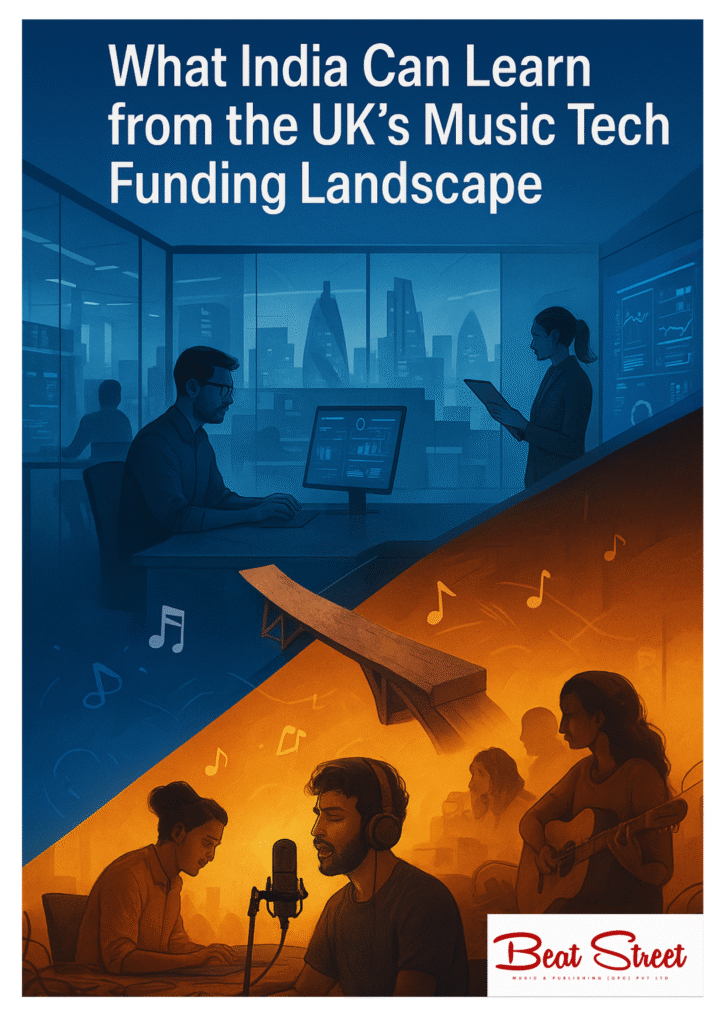
    A new UK report on music tech funding reveals critical gaps in support for innovation. For India’s booming music market, these lessons aren’t just interesting; they’re an urgent wake-up call to build the infrastructure our creators deserve.

    When Music Technology UK (MTUK) released its Sound Investments’ report earlier this month, one theme stood out: innovation in music tech is moving fast, but funding and policy support are still playing catch-up.

    I found myself reading it less as a UK story and more as a mirror for India.

    The UK’s Funding Landscape

    The report doesn’t just celebrate startups experimenting with AI composition or next-gen royalty systems. It also highlights the gaps: fragmented support networks, too little growth capital, and the difficulty of turning a smart prototype into a scalable business.

    Even with government recognition of creative industries, music tech often feels like the “niche within the niche.” Seed funding is available, but scaling beyond that remains the real hurdle.

    India’s Parallel Reality

    I’ve seen promising startups stall.India’s context is different but surprisingly parallel.  Just last week, I spoke with a founder building a brilliant solution for Indian regional music but can’t get past the investors because they don’t understand the market. They want them to shoot regional songs in UK! 

    Streaming consumption is surging, short video and OTT platforms are reshaping listening, and we have no shortage of tech talent.

    Yet ask yourself: where are the dedicated music tech funds?

    I’ve seen promising startups in rights management, metadata standardisation, transparent royalty accounting, and sync tools stall; not because the ideas lack merit, but because the funding pipeline doesn’t exist. Unlike the UK, where at least there’s structured dialogue, India hasn’t even begun to place music tech on its policy or investment map.

    Why This Matters: It’s About the Invisible Plumbing

    This isn’t only about new platforms or apps. It’s about finally fixing the broken, invisible plumbing of our industry. The things creators rarely see but always feel: missing royalties, opaque deals, underreported plays, delayed payments.

    Without investment in this infrastructure, Indian IP risks staying dependent on global platforms instead of building long-term value at home.

    The Takeaway: A Call for Recognition

    What I admire about the UK report is its honesty. They acknowledge that capital doesn’t always flow to where innovation is. For India, that’s a wake-up call.

    We don’t need to wait for a government white paper. The time for action is now. We need investors, policymakers, and the music industry to start recognising music tech not as an add-on, but as the infrastructure that will decide whether our creators thrive or simply survive.

    Because the real question isn’t whether Indian artists will keep growing globally… they already are. The question is whether our technology and capital will grow with them, or whether that value will once again slip away to others.

  • TikTok’s Phantom Return in India: A False Alarm but a Wake-Up Call for Creators

    Last week, screenshots of TikTok’s website appearing live in India created a sudden buzz. Many thought, “Is it back?!” and hope ran high.

    But within hours, both government sources and TikTok confirmed that the ban imposed in June 2020 is still in place. What people saw was most likely a technical glitch, not a policy change.

    Still, that moment revealed something much bigger: Indian creators are starved for real platform opportunities that go beyond quick dance trends.

    The Promise TikTok Once Held

    TikTok was more than an app. It carried three powerful opportunities for the Indian music and creator ecosystem:

    • A modern-day A and R engine: a viral clip could resurrect an old track or break a new one overnight, creating real royalty flows.
    • Democratised access: anyone, from Bhopal to Bombay, had the chance to go global.
    • A vital promotional channel: especially for younger listeners, where song discovery often began.

    What Vanished With TikTok

    When TikTok disappeared, it was not just an app that vanished; it was an entire economic lifeline.

    • Creators from tier-2 and tier-3 towns didn’t vanish: they simply had to migrate. YouTube Shorts and Instagram Reels offered new platforms, but they couldn’t replicate TikTok’s intuitive design or algorithmic power. Many creators are still waiting to regain the reach and ease of growth TikTok once provided.
    • Regional voices that were finding the spotlight went quiet.
    • Shorts and Reels filled the space, but many creators never regained their reach. The algorithms shifted and visibility dried up.

    The UMG TikTok Detente

    Earlier this year, Universal Music Group pulled its catalog from TikTok in a major licensing showdown. That dispute has now been resolved, and with it came new protections for artist rights and restrictions on AI misuse.

    This is important for Indian creators. It shows that platforms can be negotiated with. But this only happens when artists, publishers, and managers know the value of their work.

    Your Arsenal – What Artists Should Do Now

    For Indian creators, the TikTok “phantom return” is a reminder to build strong foundations. Some immediate steps:

    • Treat metadata as your digital deed : always embed ISRC and ISWC codes before publishing. Today, over sixty percent of Indian indie releases still lack them.
    • Diversify your reach : do not depend on one algorithm. Build communities through WhatsApp, email lists, YouTube, and regional platforms.
    • Know your value : when licensing, insert strong terms and penalty clauses to prevent misuse.
    • Use AI wisely : great for demos and marketing, but never as a substitute for your creative soul.

    The Indian Moment – Are We Ready?

    If TikTok ever does make a formal return, it will come with strings attached; local compliance, data rules, and Indian partnerships. The bigger question is not if it returns, but will we be ready.

    • Will metadata be clean and consistent?
    • Will creators be able to carry their audiences across platforms?
    • Will contracts protect rather than exploit them?

    The phantom return may not have delivered change, but it revealed exactly what needs fixing: metadata, rights clarity, and smart diversification.

    Final Word

    If you are building a music career and want to safeguard both your art and your business, let us connect. The right strategy today ensures your music earns fairly tomorrow.